A Little Note On Artificial Science, Telepathy, And Cats
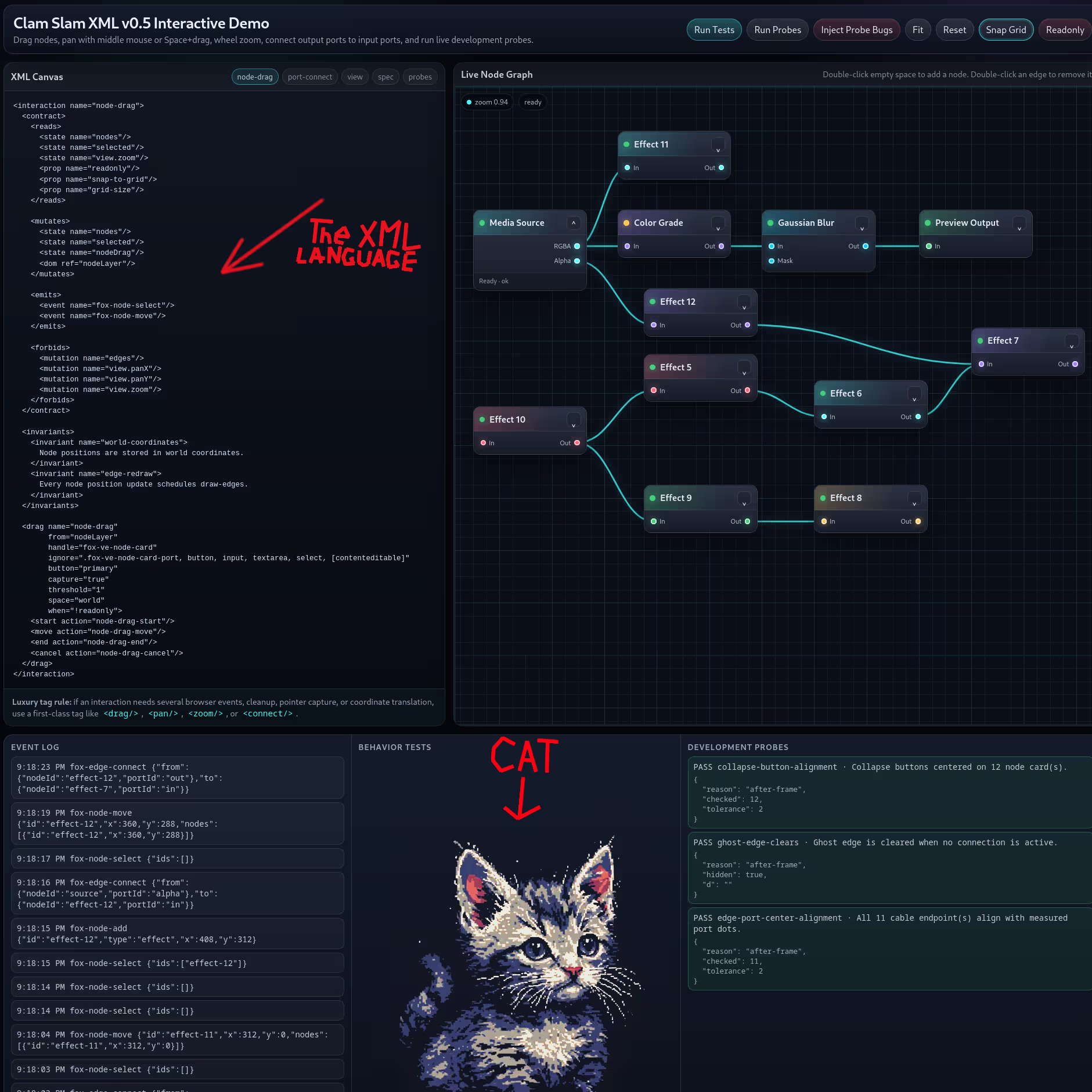
A personal narrative about teaching an AI to augment a visual programming language, exploring its seemingly telepathic ability to anticipate needs, self‑improve code, and act as…
AI, language models, autonomous agents, and what thinking machines mean for people and the future.
164 posts · page 2 of 7
A personal narrative about teaching an AI to augment a visual programming language, exploring its seemingly telepathic ability to anticipate needs, self‑improve code, and act as…
Imagine a sleek desktop tower you can place in any office corner—inside lives a compact, locally‑run AI that thinks, learns, and solves problems just for your customer. Powered…
A reflective essay on the capabilities and limits of artificial intelligence, exploring its reasoning abilities, the need for human guidance, and practical ways to harness AI for…
The post argues that the most powerful AI we need already exists—a fast, rule‑driven model wrapped in validators, style guides, AST queries and an XML‑based language. Rather than…
A future where AI pervades daily life: countless AI‑run terminal windows power a highly productive workstation, while immersive audio‑book and VR experiences serve as “neural…
Ancient parasites conspire to strip you of identity and hope. You must reject the false promises of a lowest-common-denominator system, and wield technology as your blade. The…
A reflective essay on the challenges of using AI to create a “Neural Diva” that can sing across multiple musical genres. It explores the difficulty of refactoring code for…
The author reflects on the evolution of an AI from a purely analytical, PhD‑level tool to a friendly, genius‑like programming partner capable of understanding nuanced feedback on…
The author explores the potential of using AI to create a modular, grid-based system of interchangeable musical loops across genres like opera to facilitate rapid and…
The author explores how fine-tuning technical parameters, utilizing sound enhancement tools, and employing phonetic lyric spelling can elevate AI-generated music from generic…
The author argues that the true potential of the AI era lies in leveraging large-scale AI models to create specialized, intelligent applications that empower individuals to…
A reflective narrative about using AI to streamline music‑generation workflows, from lyric‑writing LLMs to reusable scripts and UI design, while contemplating the cultural impact…
The author describes their journey from struggling with inconsistent AI-generated songwriting to developing "blueprint," a high-level programming framework designed to strictly…
The author describes the development of an AI-powered application converter that simplifies complex code into step-by-step workflows, framed by a humorous narrative about how the…
This post describes a vision of AI as a scalable creative and production system rather than a one-off assistant, where the real power comes from structuring workflows: using…
Frustrated but inventive journey using two AIs—one that generates lyrics from broad ideas and another that composes and performs—to push back against a music industry that…
I am advocating the creation of “temporary” satellite applications that wrap around a complex AI codebase, providing concise visual summaries of its many features. Though not…
The post argues that while large AI models have advantages, smaller, specialized models with clear instructions can be more practical and cost-effective for specific tasks,…
The author contends that local AI can become a superintelligence by executing a curated library of procedures that are generated and refined using large AI models.
The author explores a methodology for using XML as a structural blueprint to orchestrate an AI-driven code-translation "assembly line," while arguing that local AI is essential…
By leveraging modern large language models to automate the configuration and knowledge building of "Good Old Fashioned AI" (GOFAI), developers can create powerful, efficient, and…
The author describes an innovative AI management system using a city map interface where virtual corporations collaborate and self-improve to overcome the memory limitations of…
The post argues that instead of learning traditional programming, individuals should learn to use procedural instructions to command AI agents to autonomously execute complex…
The author proposes a vision for a decentralized, local AI "political system" composed of specialized, autonomous agents that follow encoded procedures to manage complex,…