Do Not Let Schools Trick You, You Are Very Smart

Do Not Let Schools Trick You, You Are Very Smart

zoom read listen

The post argues that genuine learning comes from personal curiosity, playful exploration, and real‑world projects—rather than forced textbook work—and claims that traditional schools often rob students of this freedom.

#0371 published 13:46 audio duration 1,392 words 8 links education self-learning programming raspberry-pi portfolio music art physics chemistry math games youtube

What Does The Adventurer Seek?

What Does The Adventurer Seek?

zoom read listen

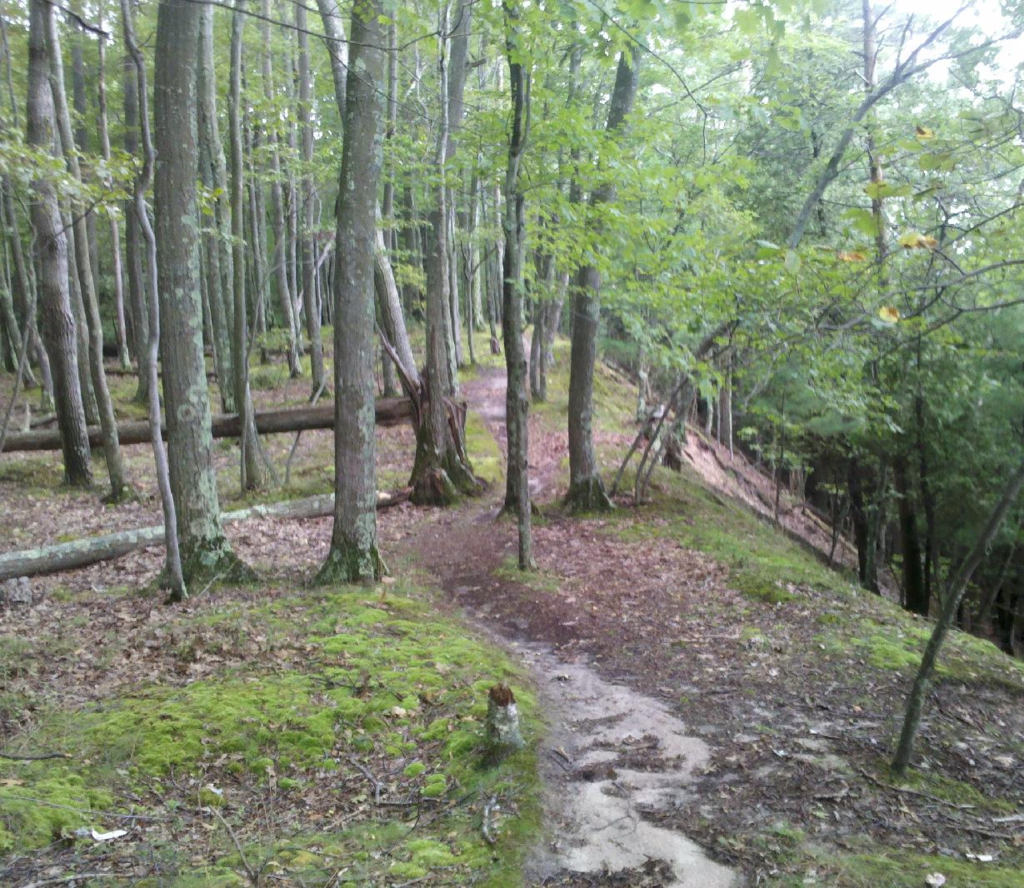
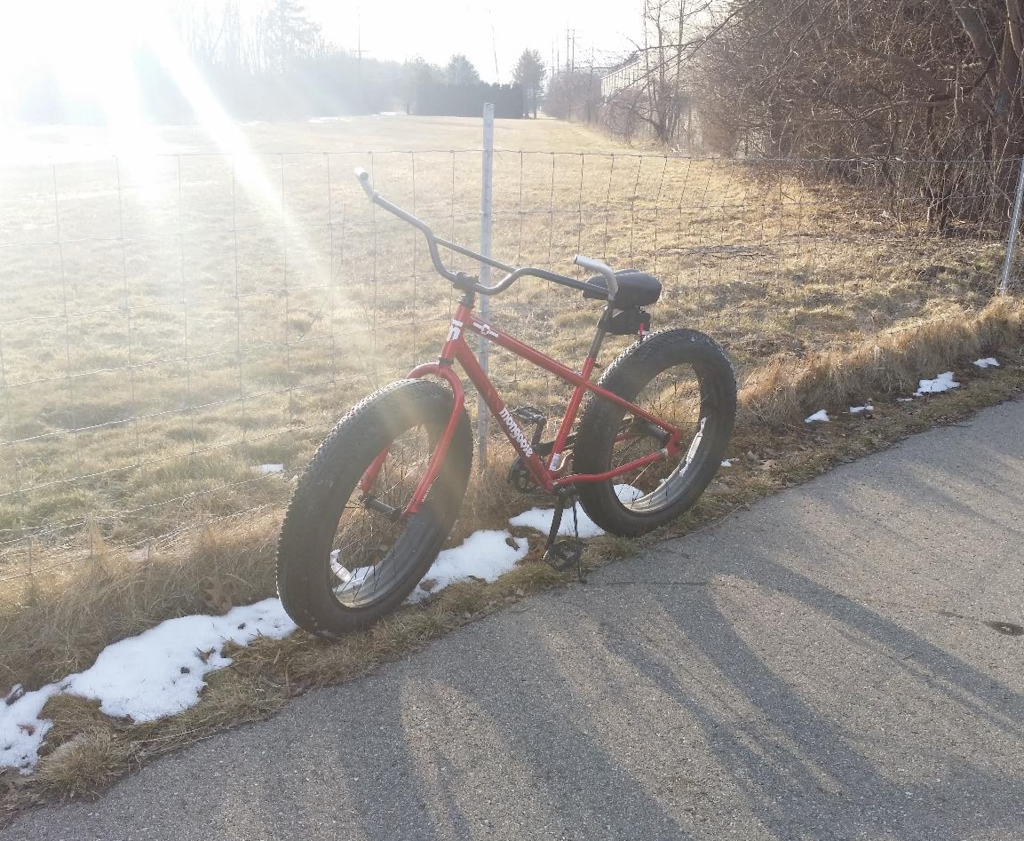
Walking through long trails in nature gives the narrator a new view of life, letting him forget city worries and feel his body heal as stress fades; he notices animals, sights, sounds, and slowly regains health, balance, and curiosity. The experience transforms him into a more authentic, creative person who, after returning to the city, feels confident, writes, paints, composes, and reads about physics and philosophy, and uses this knowledge to help others. In short: the journey on trails brings healing, insight, creativity, and a renewed sense of self.

#0370 published 07:54 audio duration 768 words hiking trail nature storytelling travel

Song Structure Tutorial with Lil Jazz And His String Orchestra

Song Structure Tutorial with Lil Jazz And His String Orchestra

zoom read listen

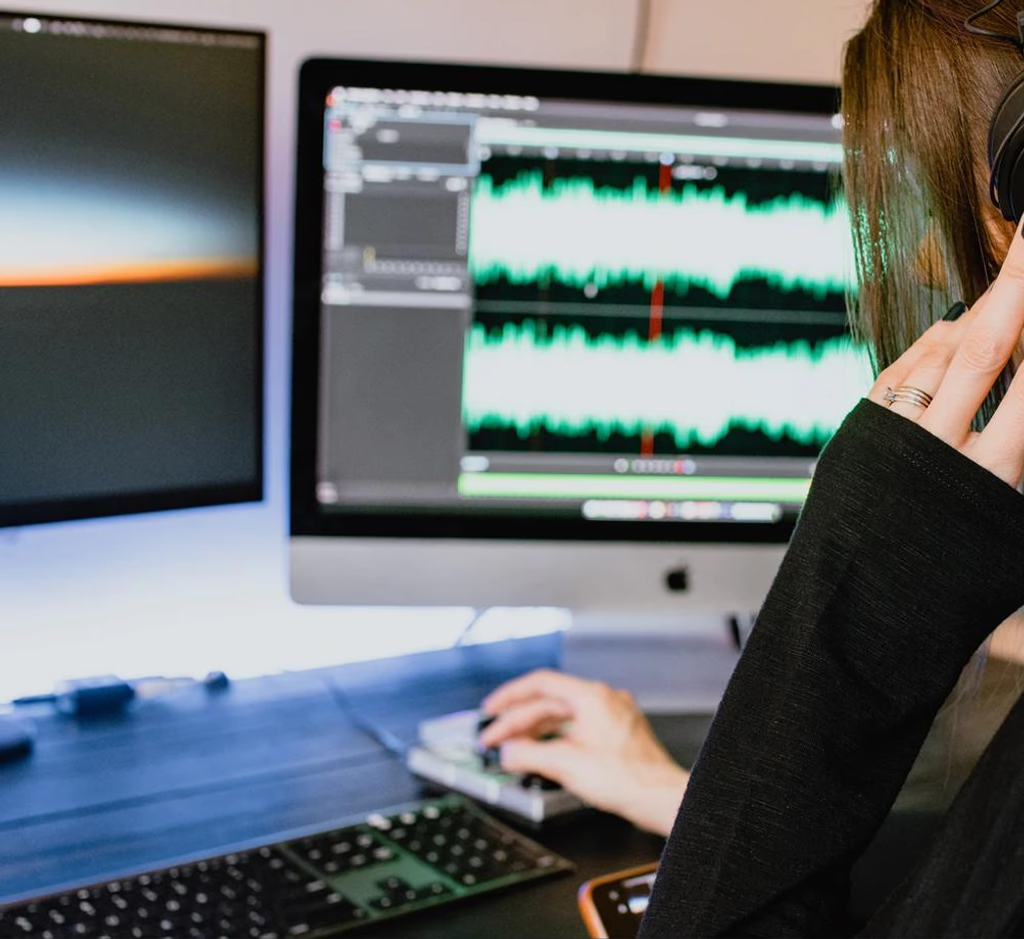
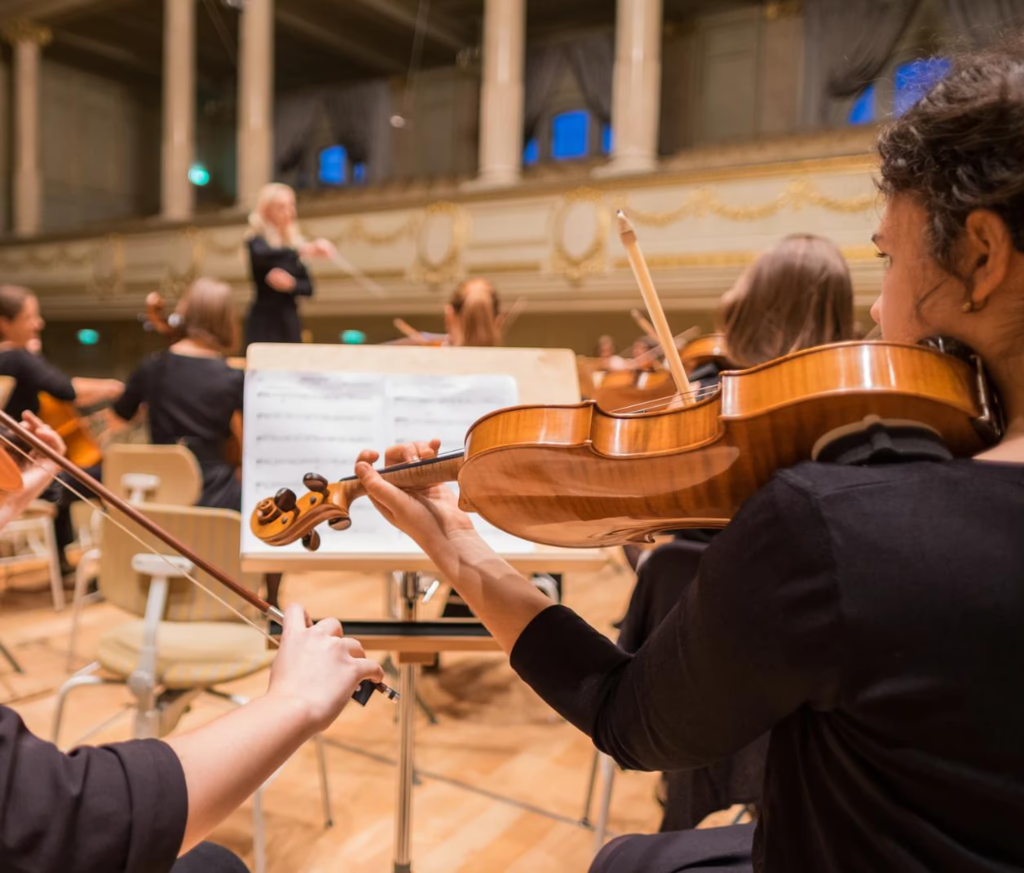
The post explains how to grasp a song’s structure by listening and then outlines a simple, repeatable framework—opening, intro, action 1, rest, action 2, closing—with each section optionally split into two halves to build tension. It describes the author’s own composition using this model: an opening with slow‑then‑fast parts that mirror in the closing (but reversed), a two‑part intro that introduces drums for smooth transition, two‑half actions driven by strings, a central rest featuring flute to give listeners a delicate break before building back into action 2, and a final action echoing the first but enriched with piano from the opening. The author concludes by presenting the finished track and sharing its audio file.

#0369 published 08:39 audio duration 449 words 1 link song structure composition arrangement instrumentation drums flute piano strings

How To Create A Tiny Product

How To Create A Tiny Product

zoom read listen

The post argues that by creating tiny, low‑effort products—digital images, Bootstrap card kits, or handcrafted kits—and learning from quick failures, you can build a portfolio of simple, valuable items and test ideas in the market.

#0368 published 05:40 audio duration 632 words 17 links pixel-art image-magick colorhunt hsl-color-model creative-market bootstrap-card stripe-integration makerspace shapeways ponoko etsy raspberry-pi-case mvp product-iteration 3d-printing laser-cutting

On Finding A Path To Greatness

On Finding A Path To Greatness

zoom read listen

Prioritizing mental well‑being first, the post urges building a rich, self‑directed intellectual foundation—via audiobooks, exploration, and reflection—and then translating that knowledge into practical business or creative projects to shape one’s own future.

#0367 published 24:14 audio duration 2,771 words 37 links mental well-being self-help entrepreneurship learning audiobooks hiking journaling business ideas 3d printing drone racing painting murals color theory portfolio

The Experimental Class

The Experimental Class

zoom read listen

The post describes a student’s journey from high school through college and into work, framed by a series of classroom incidents. It opens with an awkward moment in a news class where the teacher gives a kid a “wet willy” after he falls asleep; the narrator leaves the room and later meets the soon‑to‑be principal who creates a new class marked by a poster saying “Wherever you go there you are.” The classmates then discuss their feelings, and the narrator drops out early, receiving encouraging wishes from his peers. After earning his GED, he enters college, lands on the Dean’s list with a 4.0 GPA, and ultimately becomes a programmer—learning at his own pace—and reflects on how these experiences shaped his path.

#0366 published 04:27 audio duration 557 words 1 link school teacher class student narrative personal-essay education college

How Your Generation Can End Fraud And Corruption

How Your Generation Can End Fraud And Corruption

zoom read listen

By designing simple ES2020 programs that pose user questions in function calls—such as determining the humane nature of the three‑strike law or whether to call police—the author envisions a transparent, self‑adjusting decision system that limits damage from liars and can evolve through human input and voting.

#0365 published 12:32 audio duration 1,428 words 2 links poetry programming javascript es2020 functions web-development chat-interface rule-engine system-architecture automation

So, What Is Learning Anyway?

So, What Is Learning Anyway?

zoom read listen

The post begins by distinguishing “teaching” (someone else instructs you) from “learning” (you actively seek knowledge) and notes that studying for exams is often just memorization, which the author argues is only a temporary recall skill. Drawing on his own experience learning English through watching cartoons, closed captions, and moving to America, he illustrates how immersion and personal motivation let him internalize language naturally, whereas textbook study or Shakespeare gave little effect. He stresses that true learning depends on interest—“love” for the material—and criticizes schools’ reliance on forced memorization, arguing it stifles curiosity and produces shallow knowledge. Using math as an example, he claims that when students learn concepts through real applications (e.g., building games or programming) they retain them far better than when merely reciting formulas.

#0364 published 10:11 audio duration 1,112 words 9 links learning self-study language-acquisition memorization studying teaching

The Way The World Is

The Way The World Is

zoom read listen

The post begins by praising humanity as great thinkers, dreamers, and leaders, then laments that our systems still fail—students are overcharged for education, mental health is neglected, poverty and homelessness rise, and people end up in prison instead of care; the author calls on us to recognize these mistakes, document them in personal journals, and propose concrete solutions (e.g., rethinking medical school structures, paying students, reducing memorization). By recording each wrong and its fix, we can build a collective plan that will eventually lead to an integrated world where borders disappear, debt is managed by universal credit, prisons become institutions of care, and humanity truly fulfills its potential.

#0363 published 05:52 audio duration 544 words 1 link poetry reflection education economics socialcommentary journal future

Little Adventures At Nordhouse Dunes

Little Adventures At Nordhouse Dunes

zoom read listen

I drove from Ludington through a series of winding roads—West Nurnberg, West Forest Trail and Porter Creek—to reach the Nordhouse Wilderness Area, where I parked at a small loop near the trailhead and set up camp with a tent and firewood. After gathering logs for a fire, I explored the dunes and woods on the Arrowhead Trail, discovering a new fork that led to a towering dune overlooking Lake Michigan, which offered an impressive view and a quiet spot to sit and listen to my audiobook. Returning to the campsite, I roasted sausage over a campfire, watched the sunset, and slept under the stars while listening to “Electric Universe.”

#0362 published 09:10 audio duration 1,272 words hiking camping roadtrip north-michigan us31 us10 westforesttrail nordhouse-wilderness dunes lake-michigan audio-book

For Contributions To Human Kind

For Contributions To Human Kind

zoom read listen

The author urges a student to pursue a prestigious prize by following a deliberate path: early SAT preparation, enrollment in a top university, entry into cutting‑edge research labs, and focus on anomalous discoveries such as anti‑aging or DNA recombination; he stresses that luck matters but so does proactive planning, noting that schooling can be imperfect yet still offers opportunities. He cites examples like Rosalind

#0361 published 10:08 audio duration 1,148 words 7 links motivation education college research science videos

The Lighthouse

The Lighthouse

zoom read listen

I arrived at Ludington State Park and booked a tent spot after showing the booth attendant my raccoon drawings, which she liked. While setting up camp and listening to audio books on my iPod, I met a family whose son played guitar; I encouraged him to listen to audiobooks and later left early in the morning before they could talk again. A few weeks later I returned for another trip to Nordhouse, where I was recognized by a fellow hiker and we exchanged brief conversation while I listened to Paul Strathern’s “Philosophy in 90 Minutes.” After a return home, I revisited Ludington, showed more drawings, and spent the day exploring the hiking trails. At dawn I searched for a shipwreck site, met a scout who explained a baseball cap on his forehead, then proceeded up a dune to view a lighthouse and its surrounding apartment, enjoying a perfect sunset.

#0360 published 06:40 audio duration 900 words 1 link camping hiking drawing audio‑books ipod books ludington state park nature travel

Bad Grades Are Meaningless Grades

Bad Grades Are Meaningless Grades

zoom read listen

The post claims that modern schools have turned into profit‑driven businesses where grades and standardized tests drive teachers’ pay, forcing students into rote memorization instead of genuine learning, and proposes a personalized, computer‑aided education model to restore true learning.

#0359 published 11:47 audio duration 1,415 words 2 links education schools teachers grades tests programming generative-art math learning personalized-education

Real Education Is Everywhere

Real Education Is Everywhere

zoom read listen

The post argues that ordinary school education is limited while “real” learning—rooted in personal interests and practical projects—is far richer: it starts by encouraging you to pursue small businesses that teach money‑making, thus ending poverty and job anxieties. From there it moves through creative arts (photography, portrait drawing, oil painting), music composition with tools like LMMS, and programming/automation using Linux, streams, and event emitters—skills that automate art, compose music, and eliminate warehouse needs. Mathematics is presented as a simple tool for generative music and games, while reading and listening expand into science, electronics, robotics, and drones. As knowledge grows, so do disciplines like philosophy, psychology, education, engineering, entrepreneurship, leadership, and wisdom, culminating in sharing what you learn through audio books, written works, and a portfolio that showcases your experiments and videos.

#0358 published 05:52 audio duration 643 words 15 links education photography drawing music programming linux streams events automation generative-music pixel-art books science electronics single-board-computer sensors robotics drones portfolio

The Terrible Truth Behind Piano Keys, Scales, Schools and Uneducated Politicians

The Terrible Truth Behind Piano Keys, Scales, Schools and Uneducated Politicians

zoom read listen

The post argues that modern schooling, especially in music, reduces learning to rote memorization of theory rather than creative expression; it claims schools treat music as a single block of facts that students must recite for grades, while teachers merely deliver content without tailoring it to individual learners. The author likens musical scales to color palettes—simple pre‑selected sets that allow musicians to express feelings—and suggests that true learning happens when students can freely choose and play in a given scale rather than cram notes. He extends this critique to politics, saying politicians act like actors who perform for votes, and calls for interactive visualizations so both learners and voters can see results clearly. Ultimately he proposes a personalized curriculum built by students, not imposed by teachers or standardized tests, to restore genuine learning and creativity in schools.

#0357 published 13:28 audio duration 1,424 words 1 link music theory music education school curriculum pedagogy student learning teacher perspective musical scales memorization standardized testing creativity color analogy interactive visualizations personalized education education reform

A Little Look At Little Melodies

A Little Look At Little Melodies

zoom read listen

In the post the writer uses “Happy Birthday” as a simple illustration of how melodies can arise from singing or playing on instruments, noting that they often start with words and then develop into music. They explain that a melody alone feels incomplete until it is supported by chords and bass, which give depth and structure to the piece. Using LMMS for key selection and automatic chord conversion, the author demonstrates each component—melody, bass, chords—in isolation before layering them together, showing how the final song gains fullness when all parts are combined. The post concludes with an audio example of the completed composition.

#0356 published 11:27 audio duration 869 words 3 links music composition melody chords bass piano lmms audio production tutorial

A Tiny Introduction To Drums

A Tiny Introduction To Drums

zoom read listen

The post discusses how modern drum production blends synthetic samples with real recordings, noting that less computer‑like a drum tends to sound better. It explains the four main drum types—kick, bass, snare, and tom—and illustrates each with examples. The writer then describes common rhythmic patterns such as four‑on‑the‑floor and the added backbeat, showing how adding a beat on every other pulse can make a simple groove more engaging. Finally, it mentions layering drums and incorporating additional elements like claps or hi‑hats to create richer textures, encouraging musicians to experiment with mixing sounds while appreciating the instrument’s history.

#0355 published 06:47 audio duration 450 words 4 links drums percussion audio recording synthetic drums drum kit four-on-the-floor backbeat hi-hats

Exceptional Ability As A Tool For Thinking

Exceptional Ability As A Tool For Thinking

zoom read listen

The author introduces “Exceptional Ability” as a personal measuring stick—a way of thinking about one’s own talents beyond the usual school‑to‑college path—first noting its origin in the U.S. Green Card process and later use by CEOs as an alternative to a diploma. He argues that high school and college are merely starting points, not guarantees of exceptional ability, and invites readers to ask whether those institutions really deliver it. To cultivate this unique skill he suggests practical “compass” activities such as trail hikes and marathon training, and stresses that proof comes in creative works—books, journals, poems or other original productions—rather than grades. In short, the post presents Exceptional Ability as a private, self‑evaluation tool that can guide one’s lifelong learning and eventual leadership outside conventional schooling.

#0354 published 09:01 audio duration 1,033 words high school college appalachian trail pacific crest trail trail running self education book writing autobiographical journal personal development exceptional ability education reform

Schools Are Bad For Us So Build Better Schools And Don't Look Back

Schools Are Bad For Us So Build Better Schools And Don't Look Back

zoom read listen

The post describes a new educational model focused on happiness and self‑chosen learning spaces: students select classrooms that make them smile. It highlights the absence of traditional subjects like biology but offers specialized presentations—anti‑aging, synthetic life, astrobiology—and a CRISPR 3.1 lab for practical applications. Musical instruction is framed as instrument making, song publishing, and music‑label startup support, while the overall message urges building schools forward without retrospective explanations.

#0353 published 02:08 audio duration 196 words 6 links new schools biology anti-aging synthetic life astrobiology crispr instrument making song publishing music label start-up accelerators building

Trying To Sing

Trying To Sing

zoom read listen

In this post the author explains how to craft your own songs by syncing personal thoughts and lyrics with a metronome or simple beat, stressing that a steady rhythm can guide you when words or melodies feel stuck; they advise keeping words short (or splitting long ones) so the song flows naturally. The writer illustrates the process with an example, noting that the key is finding a path through a lyrical maze and adjusting phrasing until it shines. They also share their own early attempt—a track recorded in 3‑second takes—describing how they used drums as a backbone and added reverb to their voice, while experimenting with piano or violin for richer sound. Finally, the post ends with a short poem titled “No Limits” that celebrates limitless creativity and personal growth.

#0352 published 06:30 audio duration 466 words 1 link songwriting lyrics music beat metronome

You Do Not Need Theory

You Do Not Need Theory

zoom read listen

The post celebrates the freedom and creativity that come from breaking out of conventional music theory and academic expectations. It urges musicians—especially young composers—to trust their own instincts, experiment boldly, and not be bound by rigid scales or formal instruction. By embracing their unique voices and “inventing” new ways to understand sound, they can compose freely, inspire others, and leave a lasting mark on the world of music.

#0351 published 06:13 audio duration 547 words 8 links poetry music theory composition songwriting creative writing

Fake Schools, Fake Education And How To Spot A Creepy Cult Of Greed

Fake Schools, Fake Education And How To Spot A Creepy Cult Of Greed

zoom read listen

The post argues that the current educational system is dominated by “fake” institutions that charge students for tuition and profit from their future earnings, while genuine learning should be modeled after Y Combinator—a startup accelerator that hands out funding in exchange for equity—so that schools become real partners in a student’s career. By contrast, the author calls for new “School 2.0” universities that grant personalized curricula, early company formation, and only take a modest share of graduates’ profits; such institutions would give students financial independence rather than debt, and ultimately replace the corrupt, tax‑exempt schools that sell a fantasy. The post ends with an invitation to build this honest university model for future valedictorians.

#0350 published 07:38 audio duration 769 words 5 links youtube y-combinator school-2.0 personalized-education startup-accelerator tuition-fees curriculum-design financial-independence

Get Mad: Of High School And Music

Get Mad: Of High School And Music

zoom read listen

The post argues that high‑school music lessons should move beyond rote theory and instead focus on hands‑on creation—using tools like LMMS to produce full albums of ten songs—and encourage students to monetize those tracks for business use. It claims that current classes feel “brainless” because they only teach simple elevator music or background loops, leaving students frustrated and underprepared for real work. The author urges teachers to let students launch small businesses (e.g., workout‑music production) right after the first semester, turning learning into a practical skill that can generate income and break the cycle of student debt. In short, the piece calls for a shift from memorized theory to genuine, entrepreneurial music education that empowers students to create, license, and profit from their own work.

#0349 published 07:25 audio duration 781 words 5 links music education highschool lmms audio-production digital-audio-workstation circle-of-fifths student-debt business

How To Easily Learn Anything And Everything

How To Easily Learn Anything And Everything

zoom read listen

The author argues that traditional schools pick subjects arbitrarily, force students into memorization rather than real learning, and ultimately fail to provide meaningful knowledge or practical skills—especially in math—leading to a cycle of debt and uncertain employment; they suggest that true education comes from self‑directed projects (e.g., 3D printing) where the subject matter is directly relevant, sparking passion and enabling entrepreneurship, so that graduates can create their own businesses and earn income without relying on minimum wage jobs or costly degrees.

#0348 published 09:41 audio duration 1,045 words 1 link education self-education school math 3d printing startup entrepreneurship technology