
#0455
Rising Above
The post claims schools fail to foster true individuality, urges readers to follow their own path and collaborate on repairing money and societal systems so each person can live a beautiful, self‑actualized life.
Archive
Page 19 of 101
#0455
The post claims schools fail to foster true individuality, urges readers to follow their own path and collaborate on repairing money and societal systems so each person can live a beautiful, self‑actualized life.

#0454
The post celebrates the power of united human wisdom and calls for abandoning national borders, rigid beliefs, and petty deceptions that keep us blind; it urges a collective effort—through shared learning, reading, adventure, and self‑education—to align our will and intelligence so that humanity can enter a new Renaissance of science, politics, and art, ultimately ending the tricks of liars and achieving prosperity, wisdom, and peace.

#0453
The post reflects on how “to think” means to out‑think others—especially political liars and analysts who out‑think voters—and extends this idea to space‑opera writers and the scientist’s rule that if something can’t be proved, it doesn’t exist. It then links consciousness, choice, and freedom of will to a universal family of beings capable of wise decisions, citing Giordano Bruno as an example of sending messages into the future. Finally it urges readers to combine consciousness with wisdom, clarity, and truth in order to solve planetary problems such as climate change, nuclear weapons, and extinction, while encouraging love for animals and rise toward a greater informed consciousness.

Writing, as the author argues, is humanity’s most enduring invention—an art that links people across time and space when done with intention and care. The post showcases a range of lasting forms—from Socrates’ oral teachings turned into books, to Leonardo’s creations that invite understanding, to poetry and sculpture that capture eras—and stresses that each must be deliberate, meaningful, and beautiful to survive. It proposes building large journals filled with doodles and photographs, photographing them to create a tangible record, and then letting the work “entangle” the creator’s spirit into the art. The author believes that by learning from philosophers, combining their insights, and using narrated books as vessels for our thoughts, we can elevate ourselves into “great beings.” In short, the text is an exhortation to craft deliberate works of art and thought, preserve them, and let them carry our spirit through time so that future generations may rise with the same creativity and depth.
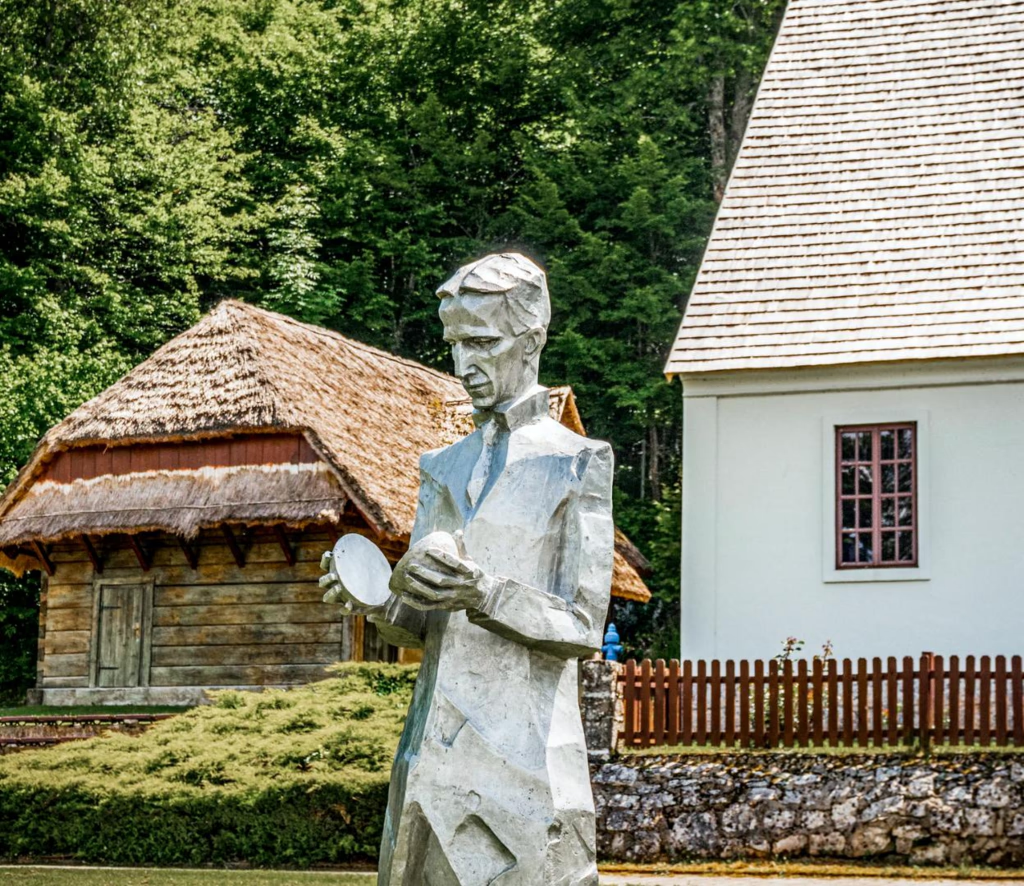
Innovation comes from observing everyday objects, combining existing ideas into new creations that are simple, lightweight, and naturally fit together; by paying attention to details, relaxing, and letting components click, anyone can invent—no special powers required—and the poem encourages walking or biking while keeping an eye on useful items, so even a rubber band could become a wallet for keys and cards.

I began my life as a self‑taught “little scientist,” sketching and writing from an early age—my first book titled *Kosmos* was a scribble of curiosity—and continued experimenting with plants, building strange hybrid trees in a garden that felt like a laboratory. Though I never became a professional, I persisted through school, programming on an old Sharp Zaurus SL‑5500, crafting tiny Perl scripts and generative art projects such as shadow references for figures; I even made miniature horses from sticks inspired by Theo Jansen’s videos and built slingshots that remain my favorite toys. My adventures are always “expeditions” rather than simple walks: a lonely hill with rain makers led me to giant deer that shook me, yet the mystery itself—footprints in snow, footsteps all around—remained a puzzle I enjoyed solving. Through it all I kept writing, learning, and never letting teachers or bullies stop me; for me, each new lesson is a path that expands my universe, reminding that inside everyone lies a scientist, an artist, and an inventor.

#0449
The post likens mastering parkour or skateboarding—requiring persistent practice and genuine learning—to the way individuals should approach any skill, including politics and personal development; it argues that those who merely pretend to be skilled are quickly exposed, while true progress comes from continual effort. In politics, the author notes that lies go unchecked unless proven, which keeps leaders stagnant just as climate action and deforestation remain neglected. He therefore proposes that humanity must grow beyond its present state, with personal mastery driving collective advancement: reading, listening, and applying accumulated knowledge to a single pursuit yields wisdom, ultimately enabling us to contribute meaningfully to the world.

#0448
The post argues that true growth happens when one leaves rote schooling behind, pursues diverse self‑learning in science, art, and practical skills, and uses this knowledge to become a noble, impactful being for the world.

The post is an exhortation to write a compact, pocket‑sized book that distills the author’s lifetime of learning into a handful of pages for future readers; it stresses that such a book must be carefully titled, physically accessible, and full of compressed wisdom drawn from both the writer’s own experiences and those of others who influenced him. It argues that this self‑education is essential to achieving greatness, both in mind and vision, and that the act of writing itself requires time, reflection on mistakes, and a willingness to transform one’s life for the better. The author believes that when another person finds the book—perhaps at a terrible moment or simply by chance—the words will resonate with them as they did with him, bridging centuries and connecting lives through shared insight.

#0445
The post reminds us that true success is measured by what we accomplish, not merely by titles or jobs, and urges us to use our accumulated wisdom to break free from old molds. It claims it’s never too late for the mind to grow and become great, that each of us was meant to help the world rather than just be an employee, and that our growth is endless—beginning with small steps and expanding into a lifelong journey. The author calls on all of us to unite in tackling global challenges such as climate change and arms races, to bring real teachers into play instead of fake schools, and to let our work be driven by the desire to serve the world rather than office stress. In short, we are invited to see ourselves as free‑minded beings whose daily efforts, though never simple, will deepen in meaning with each passing day.

The poem celebrates individual initiative and genuine care for the world, urging each person to act regardless of size or knowledge, to think, dream, and transcend ordinary limits; it emphasizes that through personal effort and appreciation for all beings we can unite humanity’s future, encouraging confidence in our wisdom and creativity while inviting us to write the story of tomorrow together.

The post celebrates life’s long, magnificent journey from the beginning into the future, urging readers to live fully and never stay down. It frames each day as adding to a “magnificent whole” through body, mind, wisdom, and dreams, while describing life’s trials—hellish tests, dreamlike adventures, encounters with nature—as opportunities for growth and resilience. The author calls for personal transformation into a higher self, which he equates with human dignity and nobility: peaceful warriors, inspirational teachers, powerful thinkers, lovers of wisdom, and great beings who inspire others to do the same. By mastering knowledge, philosophy, science, foresight, and future visions, we can end reliance on fake education or imagined heroes and remember that all of us are meant to become great beings.

The post argues that while humans share biological similarities, each person’s intellectual life is uniquely their own; the error of assuming we are like everyone else leads to repeated mistakes and wasted wisdom. It stresses that consciousness gives us individuality, and that true learning comes from adopting useful cultural knowledge but discarding what isn’t worthwhile. Loneliness can be cured by striving for belonging through hard work and personal growth, not merely by joining a group because one was born into it. Greatness demands continuous effort, knowledge, wisdom, and a lasting legacy; even if medicine never extends life indefinitely, immortality is achieved by leaving an enduring impact. Ultimately, humanity must progress by each individual taking responsibility for education, meaning, and the relentless pursuit of excellence.

In this whimsical reflection, the author recounts various introductions at tech events—calling themselves a computer scientist, philosopher, troublemaker—that humorously shaped their interactions with colleagues. They recall being the butt of jokes, misidentifications, and playful references to office culture, while interspersing links to the Jargon File and personal anecdotes about programming as an art of laughter. The narrative culminates in a celebration of programmers’ creativity, joy, and the vibrant, sometimes obscure language that unites them.

The post is a beginner’s guide to starting programming on a Raspberry Pi using Node.js. It explains how easy it can be to learn by building a small, existing project called “fragrance,” installing Node with nvm, cloning the repo, linking it as a local command, and then customizing it (renaming “fragrance” in the code). The author emphasizes starting simple—using an existing template rather than from scratch—then gradually adding features, pushing changes to GitHub, and exploring the wide range of possibilities that Node.js offers on the command line, web apps, Electron windows, and even hardware control. In short, it’s a step‑by‑step recipe for turning a Raspberry Pi into a learning platform for programming with Node.js.
#0439
The author describes a human‑invented, random yet profoundly powerful phenomenon that emerged less than 200 k years ago and has grown with culture: an adaptive system that can bond to the whole mind, refine thought, weaken mistakes, strengthen powers, and even “travel in time” far beyond quantum particles. It is not natural but spread independently across cultures; it’s so potent that dictators fear it because it can snuff out kingdoms. The author then equates this phenomenon with books: a living revolution of ideas that, when read, becomes a unique universe inside each reader’s mind and carries the author’s wisdom across lifetimes—ultimately an “upgrade” for the mind.

The post argues that true understanding comes from actively listening to and reading books that resonate with you, rather than relying on formal school systems; it stresses that education is the key to reducing misunderstandings, raising global wisdom, and bringing peace, but real education is rare. It proposes that we must focus on prevention—learning now so future generations can avoid wars, climate crises, pandemics—and that knowledge scales empathy, decision‑making, and perception. The author urges us to share narrated books, fight fake education, and remember that lack of knowledge keeps the world in misery.
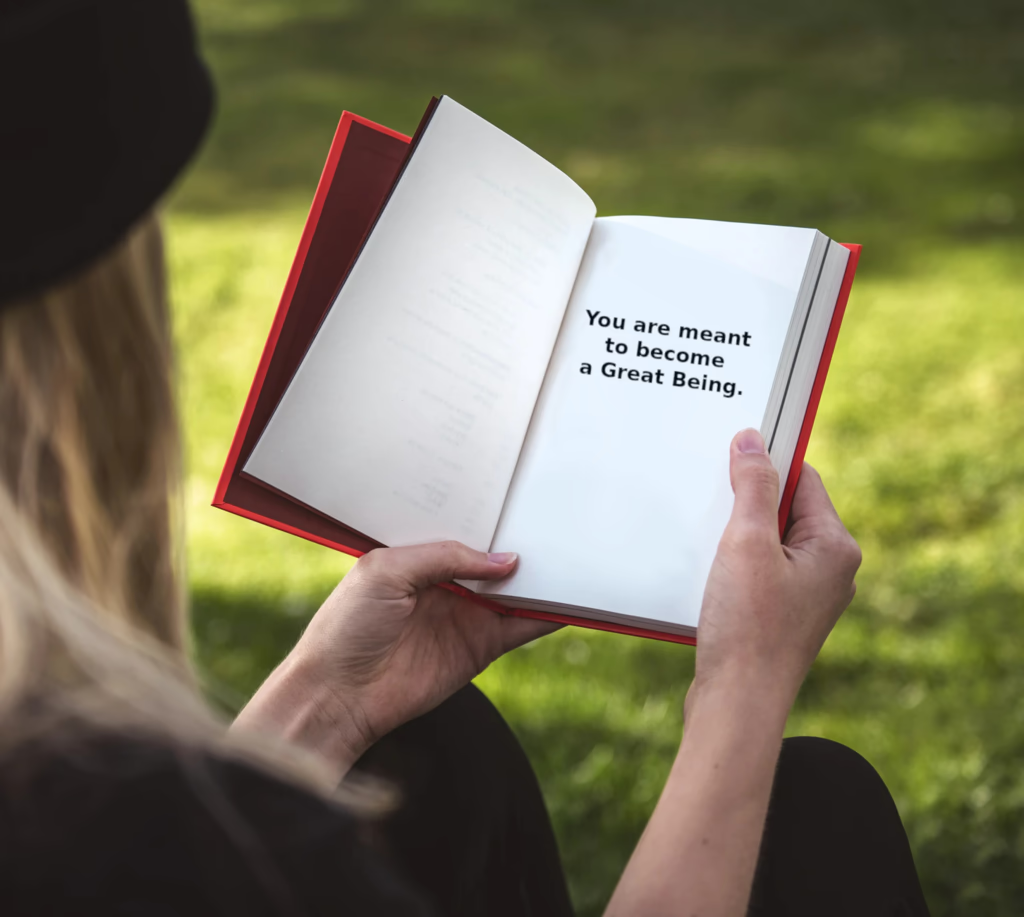
The post envisions a set of “imaginary” documents that every young person in the future should possess—an Earth Passport, a Universal Income Card, a copy of the Universal Declaration of Human Rights with an invitation to improve it, and a small book (also available in audio) called *The Manual of Life*. This Manual is compiled by the world’s most beloved scientists and philosophers, each contributing a page that may include quotes from a “Great Being” who exists only as spirit and wisdom. The book offers answers to the questions children will ask, explains how war stems from lack of education and knowledge, how poverty arises from misunderstanding money, and outlines simple lessons for growing up; it portrays humanity as one family divided only by confusion and ignorance that schools can fix. It invites thinkers, psychologists, and neurologists to share insights on cognitive biases, mental hygiene, and the discovery of our universal selves, while also leaving room for global contributions toward world peace and a wiser future—illustrated by an example entry: “You are meant to become a Great Being.”

To achieve world peace, the post argues that we must first accept that both sides of a conflict can be wrong and then act proactively through “prevention” by reshaping education; it proposes four key changes—personalized learning, active tools instead of rote memorization, global student exchanges, and recognition of teaching as valued work—to build knowledge and wisdom. By investing in these educational reforms and accompanying universal income, the author believes a new, peaceful world will emerge where children grow in knowledge and wisdom.

A proud declaration that every person is part of the creative and intellectual community—artists, adventurers, thinkers, creators, writers, and storytellers—and that each step taken brings one closer to wisdom, enlightenment, and greatness. It stresses that we are not merely workers or employees but true students of life who breathe mountain air, lead their generation forward, inspire successors, and aim for unity in peace and beauty. The post argues that knowledge is the path to wisdom, and when shared it transforms individuals and nations; by learning about other cultures one realizes that there’s nothing truly to fight over because we are all moving toward the same goal of wisdom and greatness together.

The post argues that learning continually reshapes our thoughts by adding new material to the mental framework we already possess; it stresses that thinking is not merely comprehension but also synthesis and invention, and illustrates this with a whimsical image of Thoreau chewing a biscuit in his cabin. It suggests that simple experiences—like hiking the Appalachian Trail or reflecting on Walden—can spark vast ideas that benefit future generations, urging us to leave a creative legacy rather than simply inventing for its own sake. The author uses links to videos by Seth Shostak and Richard Dawkins to show how seemingly “unanswerable” questions can be bridged from fresh perspectives, and concludes that continual learning and adventurous thinking will keep civilization moving forward and prevent stagnation.

The post is a reflective monologue about the author’s experience composing 432 poems, blending philosophical musings (a nod to Descartes’ “cogito ergo sum” and Dennett on consciousness) with playful metaphors of cars, boats, wind, and salamanders to describe the ebb and flow of ideas. He describes how each poem begins with focus but often drifts into waiting, scribbling, and confusion, yet persists until it ends in a whimsical punchline—“jabberwock.” The author acknowledges that while poems seem simple on the surface, they carry their own wings and paths, and that writing them feels like chasing a duck or riding a boat: a process full of delay, acceleration, and meandering. He concludes by noting that after finishing poem #433 he still wonders how poems can write themselves, as if written by elves.

The post opens with a parable of a young warrior who repeatedly leaps over a growing corn stalk until it becomes higher than his head—illustrating that true endurance is built by continually pushing one’s limits and repeating the challenge until mastery. It then explains that effective endurance training requires gradual, varied work so the body adapts to increasing energy demands; monotony or extreme loads alone do not build stamina. The author stresses the importance of monitoring sweat losses—sodium, potassium, calcium, magnesium—to prevent dehydration headaches, and suggests using sweat‑patch kits or laboratory tests to establish a baseline in controlled conditions, adjusting for weather and effort levels. He notes that over‑hydration can be as harmful as under‑hydration, and recommends tracking weight loss pre‑/post‑workout and replenishing with electrolytes. Finally he reminds readers that endurance is personal: it can be walking long trails or dancing; the key is steady progression, adequate recovery, and enjoyment.