Programming A Remote Controlled Portable Raspberry Pi Audio Player

Programming A Remote Controlled Portable Raspberry Pi Audio Player

zoom read listen

I built a DIY MP3 player by repurposing an old CD‑ROM drive as the chassis for a small PCB that plays pre‑converted MOD files, and I attached a Bluetooth “shutter” remote to control playback from my Raspberry Pi running Linux; after writing code that translates the shutter’s button sequences into simple shell commands (play, stop, shuffle), I can now operate the player with my phone, even routing its traffic through Pi‑hole for ad‑free listening. The project has been a satisfying exercise in tinkering and learning, reflecting my frustration with oversimplified school curricula and my enthusiasm for open‑source hardware that lets me reprogram and extend devices without costly new PCBs.

#0515 published 06:40 audio duration 757 words 10 links raspberry pi bluetooth mp3 linux pcb electronics tinkering pi-hole

From Place To Place: The Search For Talent And Adventure

From Place To Place: The Search For Talent And Adventure

zoom read listen

The post argues that travel—whether long adventures, short camping trips, or simple road journeys—offers a vital escape from overwork and a chance to reconnect with one’s own mind and hidden creative talents. It notes that while some people view travel skeptically, those who truly “take to longer travels” often feel they are stepping away from themselves; the key is support and encouragement so they can find comfort and grow. The writer explains how overwork oversimplifies life and makes us miss beauty, yet traveling gives new perspectives and helps build personal constellations of ideas. Finally, he shares a personal anecdote: after reading Bill Bryson’s *A Short History of Nearly Everything*, he discovered a love for big books and science, and now wonders if he could write short stories; he encourages readers to take small steps—camping, listening to audiobooks, painting—to become great beings.

#0514 published 05:01 audio duration 556 words 2 links travel adventure camping vacation overwork self-discovery art writing painting sculpture music books inspiration personalgrowth

The Woodland Creatures Of America

The Woodland Creatures Of America

zoom read listen

I’ve spent several years in the United States and have seen a variety of wildlife that I never encountered back home—pigeons, squirrels, sparrows, storks, deer, boars, rabbits, horses, cows, chickens, and now, American animals that feel more intelligent. My first U.S. sighting was a large possum that looked like an enormous rat but turned out to be sweet and tick‑eating; I later met a skunk whose scent lingered long after the encounter. I’ve also seen a rare, big porcupine crossing a road near a store and photographed it, though only in blur. In the woods where black bears have been reintroduced, they usually stay away from people unless curious, whereas raccoons are constantly surprising me—once stealing hot‑dog buns at Jackpine Hike‑In Campgrounds (I dubbed the thief “Friday”) and another time unzipping my tent at Nordhouse and leaving paw prints on my pillow. My advice to fellow adventurers: keep food out of tents, lock zippers, and be prepared for unexpected animal visits.

#0513 published 05:14 audio duration 651 words 4 links wildlife animals encounters usa travel

Wearable Computer Networks: Linux Audio Player Upgrade, Or The Six Key Keyboard

Wearable Computer Networks: Linux Audio Player Upgrade, Or The Six Key Keyboard

zoom read listen

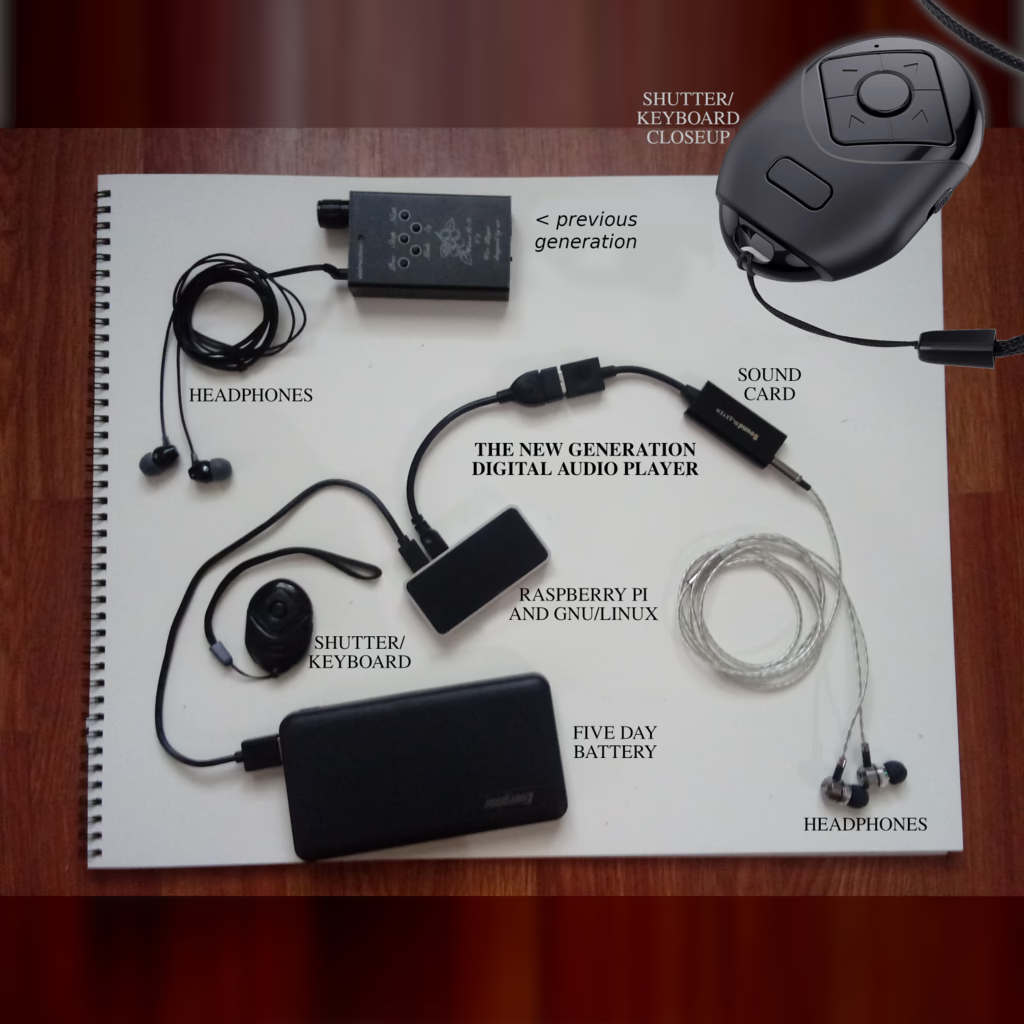
I built a minimalist portable Linux audio player that runs on battery power and an audio card without a screen or keyboard; I use a cheap Bluetooth “shutter” remote (normally used for taking photos) as a makeshift button set to control play, stop, next/previous, and volume. After wiring the shutter to my device and writing basic input handling in Node.js, I plan to expand it with a phone UI—potentially using Svelte—to stream audio or provide on‑screen feedback. The project illustrates how simple Bluetooth peripherals can turn a barebones Linux box into a pocket “server” capable of playing music, recording, making internet calls, and serving as a modular platform for future expansions.

#0512 published 04:27 audio duration 482 words linux bluetooth node.js svelte audio-player hardware open-source

Why And How Do Hackers Use Those Black Screens?

Why And How Do Hackers Use Those Black Screens?

zoom read listen

The post explains how to use the Linux command line for tasks such as playing media, downloading files, and retrieving data from APIs, illustrating with examples like using wget, curl, jq, and xargs or while loops to fetch Hacker News top stories.

#0511 published 24:17 audio duration 2,494 words 21 links bash shell command-line curl wget jq xargs loop linux json scripting

A Very Brief Overview Of Linux

A Very Brief Overview Of Linux

zoom read listen

Linux is just the kernel part of an operating system; when combined with GNU’s user‑level tools (and sometimes a different kernel like Hurd), it forms GNU/Linux, which many distributions (Fedora, Ubuntu, Mint, etc.) extend further and can be installed on open‑source hardware such as Raspberry Pi or other affordable computers.

#0510 published 13:15 audio duration 1,550 words 12 links linux kernel gnu raspberry-pi ubuntu fedora

Self Education At A Glance

Self Education At A Glance

zoom read listen

I began my technical journey by tinkering with audio files in 1996, which led me to explore early DOS graphics programs like Image72 and the first Visual Basic releases, eventually mastering HTML through FrontPage and Photoshop for graphic design; this self‑paced learning continued as I transitioned between jobs—first celebrating a 21st birthday at a bar, then diving into ASP, Perl (via FormMail), PHP, Bash, ActionScript, SQL, and Java before embracing Node.js to unify front‑end, back‑end, and desktop development with Electron; alongside this tech evolution I returned to audio editing and poetry, experimenting with plosive sounds and pop filters, while also switching from Photoshop to GIMP for design work, all driven by a philosophy of uninterrupted self‑education that guided me from college (where I created my own classes in art) to a lifelong pursuit of knowledge without institutional limits.

#0509 published 07:05 audio duration 816 words 4 links self-learning programming-languages visual-basic asp perl php bash-scripting actionscripts sql java nodejs gimp photoshop audio-editing graphic-design dos

My First Homemade Portable Music Player

My First Homemade Portable Music Player

zoom read listen

I’ve been tinkering with a Raspberry Pi Zero W since I switched to Linux in 1998, and recently built a compact music‑player for my bike by powering the Pi from a 15 k mAh Energizer power bank, streaming audio through an external USB SoundBLASTER card and headphones. After setting up ALSA so that `cvlc *.mp3` plays all my workout tracks on boot, I mounted the Pi, sound card, and power bank on the frame of my bicycle; the system runs headlessly in the background and resumes playback automatically when I reconnect to Wi‑Fi after a 10‑mile ride. The project has sparked ideas for adding a small keypad or wireless keyboard for control, a custom enclosure, and eventually a fully networked “Bicycle Linux Server” that could be managed from my phone via Termux. This experiment illustrates how a modest Pi setup can become a portable media hub with minimal wiring and command‑line operation, while keeping the learning curve low and the hardware simple.

#0508 published 07:43 audio duration 917 words 10 links raspberry-pi usb-audio-card alsa-config cvlc command-line power-bank audio-playback linux

Self Education: In Hot Pursuit Of Curiosities

Self Education: In Hot Pursuit Of Curiosities

zoom read listen

I learned how to make a Raspberry Pi button recently, and I researched it my way. [I wanted to see if there was a way to do it on the command line](https://simonprickett.dev/controlling-raspberry-pi-gpio-pins-from-bash-scripts-traffic-lights/) with the simplest kind of programming; there is. The [GPIO header](https://www.youtube.com/watch?v=6PuK9fh3aL8) is represented with files on a Raspberry Pi. I gave some thought to store‑bought devices as they relate to custom‑made ones. I think store‑bought is not that cool anymore; in his funny song “Thrift Shop” Macklemore calls it *getting tricked by a business*, to say the least. Plus the moment you scratch your screen, your new device becomes old. If you made it yourself, then you just get a new $20 screen. And, hey, maybe add some [cool extras](https://shop.pimoroni.com/products/keybow-2040) while you're at it. YEEES! It is true that homemade hardware is freaking huge, and sometimes you may need your friend to carry your phone in his backpack. But that is what friends are for… I think. There is just something really weird about not knowing what’s in your pocket versus what’s in your store‑bought phone; criminal phone hacking will only become more elaborate. It has never been a good idea to keep personal things on an internet‑connected device. The phones are going to use cheaper components, become more expensive, and more closed. And it will pretend a lot harder that recommendations are not ads. When you make your own phone, you get to reason about the components; it seems to me that a GPS map should have a huge screen much bigger than a phone, and a bigger battery too. When you use an overpriced off‑the‑shelf phone, you don't get a choice. Anytime you build something, you learn something: be it a reasonably sized Raspberry Pi Zero MP3 player with those amazing slow and soft turning aluminum knobs for volume, treble, and bass; or two or three 8GB Raspberry PIs jammed into a [beautiful vintage brick phone](https://www.ebay.com/sch/i.html?_from=R40&_trksid=m570.l1313&_nkw=vintage+brick+phone&_sacat=0) with a springy antenna that doubles as a Wi‑Fi hotspot for your 1024 closest friends… and maybe runs a leaked version of old MySpace or Friendster, or just freaking [GeoCities](https://www.youtube.com/watch?v=9jYE8VwxunQ) where your whole family can come together and upload some under‑construction content with fancy GIFs. Wouldn’t it be amazing if all the telemarketers had to find their way around a little labyrinth and fight a *Freaking Grue* before they could leave a voicemail? I am pretty sure they would love it. Old is new again; it is hard to explain, it will be somewhat hard to learn, and it will take forever. But not only won’t it cost an arm and a leg, building custom electronics and learning programming paints a pretty


#0507 published 05:46 audio duration 588 words 9 links raspberrypi gpio bash electronics hardware diy linux programming mp3player brickphone

History and Politics

History and Politics

zoom read listen

The post argues that studying history and politics is essential for understanding humanity’s present and shaping its future; it reminds readers that past mistakes repeat themselves if we ignore them, cites Kurt Vonnegut’s observation about ordinary people ruling the world to stress the need for proper education, and proposes that each of us must become teachers—learning from great thinkers and applying that knowledge to build a coherent picture of the world so as to avoid future errors.

#0506 published 04:06 audio duration 481 words 3 links history politics education learning teachers philosophy

World Poverty: Nobody Noticed, Nobody Knew

World Poverty: Nobody Noticed, Nobody Knew

zoom read listen

People often do not fight because they lack a clear cause and this ignorance is deliberately cultivated by the powerful; breaking the cycle of poverty requires real education and universal income, while a simple plastic credit‑card with a daily spending limit—linked to a bank that does not track debt or funds—could eliminate poverty without adding national debt. By providing accessible money, such cards would lift people from hunger, reduce crime and suffering, and help businesses grow, thereby advancing humanity as a unified family that must remove all barriers—including ignorance and poverty—to achieve collective prosperity.

#0505 published 04:48 audio duration 466 words 1 link poverty education credit card money family

The Human

The Human

zoom read listen

The author writes a poetic letter to Sir Ken Robinson reflecting on humanity’s evolution: we have always improved but started badly with unforgivable mistakes. He proposes shifting from “We the People” to “The Human,” urging every sector—judges, police, corporations, teachers, lawmen, military—to examine its impact and ask whether we’re helping or hurting. He calls for continuous questioning across ages and cultures until the answer is clear, and envisions future generations as mature, wise humans who will repair economies through mental health, real education, knowledge, and contribute positively to Earth.

#0504 published 10:16 audio duration 1,011 words 3 links poetry essay humanity culture education future reflection

Constant Transcendence

Constant Transcendence

zoom read listen

In this post the author argues that two common human errors—accepting things without questioning and underestimating ourselves—can be overcome with a simple double‑word mantra: “Question Everything” and “Beautiful Opposite.” The first encourages active inquiry, turning professors into teachers of questions and prompting us to ask whether war, weapons or disease truly enrich nations. The second asks us to find the beautiful opposite of our perceived shortcomings so that we can recognize our strengths (e.g., a heavy person finding his muscular side). Together these practices refocus learning on what we want to know, strengthen authenticity, and open the way for adventures and self‑realization.

#0503 published 07:56 audio duration 857 words 1 link self-improvement learning philosophy question-everything beautiful-opposite

The Wiser The World

The Wiser The World

zoom read listen

The post reflects on the idea that true wisdom comes from within and grows through continual learning, experience, and immersion in nature—fresh air, colors, sounds—and through breaking down self‑made “walls” such as habits, expectations, or superficial measures like grades. It stresses that life’s value lies in pursuing knowledge, health, and freedom rather than routine work or formal accolades; by caring for mind and body, embracing courage, and letting the world’s sunshine of experience illuminate us, we become truly unique and capable of contributing to a wiser planet.

#0502 published 07:59 audio duration 778 words poetry free-verse nature wisdom self-development travel

Let Us Become Wise So That We Know What Wisdom Is

Let Us Become Wise So That We Know What Wisdom Is

zoom read listen

In this poetic post the author celebrates growth through adventure and inherited wisdom from literature, urging readers to measure themselves by knowledge rather than birth or ego; they describe ascending as a continual climb toward greatness, with nature as our true home, and emphasize that youth’s energy fuels this pursuit—ending with a call to awaken and pursue wisdom so we may become great beings.

#0501 published 03:50 audio duration 291 words 1 link growth wisdom adventure culture nature poetry inspiration life

Answering The Calls to Greatness

Answering The Calls to Greatness

zoom read listen

The post portrays our hobbies, interests, and curiosities as a star chart guiding us toward the “call” that shapes our lives; as we mature this call becomes more sophisticated, inspiring us to pursue creative pursuits—painting, sculpture, music—and ultimately to become great beings. Ignoring it slows growth, while embracing it fuels passion, laughter, and a willingness to confront fear; through this journey we can produce poetry, books, and audiobooks that share discoveries and help others become coherent, integrated, and easy to understand. The author cites orator videos and Socrates’ lessons as examples of how wisdom can be shared, and concludes that science, politics, and culture must all grow in mind and heart by answering the call to greatness.

#0500 published 04:42 audio duration 469 words 4 links life personal development poetry writing creativity motivation philosophy

Slowing Down Art: Oil Painting, And Music Composition Require Multiple Sittings

Slowing Down Art: Oil Painting, And Music Composition Require Multiple Sittings

zoom read listen

The post explains how creating an oil painting is a multi‑day process that benefits from careful color planning, pre‑mixing, and iterative sketching—using tools such as GIMP, projectors, miniatures on plywood, and underpainting in gray to guide composition—while also exploring music composition through LMMS, code generators built with Tone.js and OOP concepts, which automate random button clicks and sample selection, yet still require manual editing for a polished track; finally it stresses that both painting and programming demand multiple drafts and long‑term experimentation, just as much time is needed to develop a song or a canvas into a finished masterpiece.

#0499 published 06:58 audio duration 757 words 8 links oil painting color mixing composition gimp lmms music theory javascript oop tone.js yeoman

There Is Only One Rule Of Adventure: You Always Stop At The Antique Stores

There Is Only One Rule Of Adventure: You Always Stop At The Antique Stores

zoom read listen

I wandered into an antique shop and spent the day hunting treasures—pets, books, guitar picks, pocket knives, VHS tapes, a large backpack for firewood, and an ammo box perfect for fossils—and found a free box of seashells that I happily scattered on the beach, turning my quirky shopping spree into a joyful adventure of collecting odd little things.

#0498 published 02:53 audio duration 368 words story antique shopping vintage collectibles

The Right To Greatness

The Right To Greatness

zoom read listen

The post argues that the world is not ending but simply out of sync, and this misalignment stems largely from how we structure education: institutions charge for knowledge, create overwork and poverty, and let GPA‑controlled grading lock students into a cycle of debt and shallow achievement. The author claims real graduation should showcase each student’s own creations, lasting beyond four years, and that brand‑name schooling only opens doors while true learning is lifelong. He invokes Socrates to emphasize teaching wisdom to future generations so they can avoid repeating past mistakes, and urges individuals to become “Great Beings” who inspire others with integrated knowledge, thereby restoring hope and driving humanity toward a wiser, more united future.

#0497 published 09:09 audio duration 878 words 1 link education school students graduation learning wisdom philosophy socrates future

Curious Things

Curious Things

zoom read listen

The author reflects on how an early idea to build an MP3 player with a Raspberry Pi sparked a lifelong passion for electronics and programming, showing that small, personally driven projects—from repairing bikes to designing custom enclosures—build a rich self‑education that goes beyond formal schooling.

#0496 published 11:56 audio duration 1,341 words 5 links electronics raspberry pi mp3 player diy self-learning bicycle repair project design philosophy

Wisdom And The Art Of Bicycle Maintenance

Wisdom And The Art Of Bicycle Maintenance

zoom read listen

After repeatedly dealing with flats and mechanical mishaps on several bicycles, the author learns to carry all repair tools and keep a spare bike ready for smooth rides.

#0495 published 17:56 audio duration 2,298 words bicycle flat tire bike repair tools cycling maintenance DIY tires pedals chain

Going And Sleeping In The Woods

Going And Sleeping In The Woods

zoom read listen

The post recounts the author's personal approach to wilderness camping, emphasizing that being a “Real Mountain Man” involves meticulous preparation—always bringing a second tent, a battery‑powered fan, mirror, toiletries, and even a hand saw mounted on his pack—and careful gear choices such as a fire starter, sleeping bag rated for low temperatures, and an inflatable pad. He explains how to stay safe in bear country: cut‑proof gloves, first‑aid kit, and a rifle or sidearm, while noting that black bears can be deterred by size and noise. The author also shares practical tips on building fires, checking ticks with repellents, and staying on trails, then recounts two anecdotes: watching a distant thunderstorm from a dune and hearing fox cries at night, and another evening where he woke to partygoers’ footsteps after a storm, illustrating the blend of adventure and everyday camp life.

#0494 published 10:11 audio duration 1,266 words 4 links camping tent sleepingbag firewood saw gear bear ticks

Adventures In Art

Adventures In Art

zoom read listen

Artists often feel they lack skill, but the key is drawing concepts—such as using an L‑shaped nose for modern graphics—and mastering color schemes and proportions. To capture a portrait accurately, photograph the subject with proper lighting, project that image onto paper, and sketch multiple drafts in charcoal or pencil to refine shadows and highlights. Oil painting thrives on layered washes and color mixing, while acrylics dry quickly and can be painted over, and watercolors allow successive layers for adjustment. Projectors (even cheap pico models) and tools like GIMP help transfer outlines and simplify colors, enabling artists to practice the same subject repeatedly—be it people, pets, or landscapes—to build confidence and skill.

#0493 published 09:09 audio duration 1,127 words 5 links drawing sketching portrait photo-realism oil painting acrylics watercolors color mixing projectors gimp pencil charcoal composition illustration

Heart Card: Helping The Human Family Converge on Wisdom and World Peace

Heart Card: Helping The Human Family Converge on Wisdom and World Peace

zoom read listen

The essay argues that poverty is a global “virus” that hinders individual and collective progress, and proposes a single, nation‑wide program to eradicate it: a central bank that issues every citizen an unlimited credit card covering food, housing, transportation, education, healthcare, and other basic needs. By guaranteeing these essentials without debt or restrictions, the plan aims to lift people out of fear, reduce crime, stimulate economies, and free minds to tackle larger challenges like climate change—all while uniting nations under a shared, borderless identity of humanity.

#0492 published 12:08 audio duration 1,282 words poverty social security bank credit card global program climate change future generations