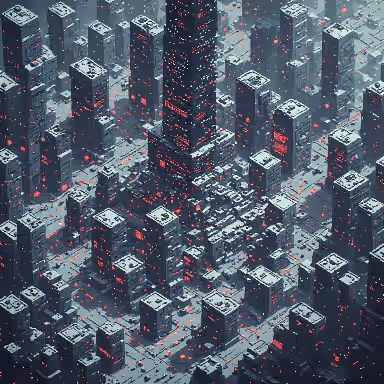
The City
There are moments in history when a door appears where, yesterday, there was only a wall.
For many people, poverty is such a wall. It is not merely the absence of money. It is the absence of tools, the absence of time, the absence of teachers, the absence of a safe room in which to practice becoming powerful. It is the heavy feeling that the future belongs to other people.
But the future is not a private estate. It is not owned by kings, corporations, universities, or the lucky few born near the right library. The future is a workshop. And now, perhaps for the first time in history, the workshop can fit inside an ordinary computer.
We have discovered something simple, beautiful, and very old in spirit.
We have discovered that the next programming language does not have to look like a wall of cryptic symbols. It can look like a city.
In this city, there are companies. Inside the companies, there are departments. Inside the departments, there are developers, artists, inspectors, librarians, and builders.
Projects move from place to place. A CSS framework company makes the foundations. A UI-kit company turns those foundations into useful parts. An application company uses those parts to create views, tools, editors, dashboards, studios, and worlds. Specialized companies then adapt those templates for music, video, games, science, education, medicine, farming, art, or whatever human beings need next.
This is not pretend.
This is a way of organizing intelligence.
The language beneath it is XML: a readable language of nested meaning. XML is like a set of labeled boxes. A city contains companies. A company contains departments. A department contains developers. A project contains artifacts. An artifact contains what has been completed, what is still uncertain, and where it must go next.
Beside XML stands the MOO: the old dream of a living object-oriented world, descended from the Multi-User Dungeons where rooms, objects, people, and verbs made digital places feel real. A MOO teaches us that computation does not have to be invisible. It can be spatial. You can stand in a room. You can inspect a tool. You can hand a package to another worker. You can see the world change.
And now beside XML and MOO stands the LLM: the large language model. Not as a master. Not as a mysterious oracle. But as a patient helper in the room with you.
XML gives structure.
MOO gives place.
LLMs give conversation, repair, explanation, and the ability for the world to evolve.
Together, they form a new generation language: XML + MOO + LLM.
This language is not meant to frighten you The learning curve is not a cliff. It is a path through a town. You begin with a single building. Then a department. Then a developer. Then a project. Then a shipment of partially finished work moving from one place to another.
You do not have to understand the whole city at once.
No one understands a whole city at once.
You learn by walking.
You enter the CSS company and learn what colors, spacing, and tokens are. You visit the UI-kit company and learn how buttons, cards, forms, tables, alerts, and navigation become reliable parts. You step into the application company and learn how views are assembled. You visit the inspectors and learn accessibility, clarity, restraint, and quality.
You visit the library and discover that knowledge can be written down as rules, facts, and concepts so the AI can take care of everything. The rules are now written for Large Language Models, they are not part of a limited expert system, but a self evolving library watched over by swarms of AI.
It can explain the room you are in. It can suggest the next tool. It can help create an Art Department, hire Bootstrap UI developers, inspect a broken layout, or move a project to a specialist company. It can help translate your intention into structure. But it does not need to swallow the entire world at once, everything is divided into parts that make sense.
The AI works through tools.
It builds the world from the inside out.
We do not ask an AI to randomly rewrite reality. We give it verbs: create a department, hire a developer, open a project, create a ticket, ship an artifact, request a review, promote knowledge. In this way, the city keeps its integrity. Every action can be inspected. Every project has a history. Every artifact has a path. Every lesson can be tested before it becomes law.
This is how ordinary people become powerful.
Not by pretending to know everything.
Not by memorizing endless syntax.
Not by waiting for permission.
But by entering a world where knowledge has shape.
A young person who has never built an application can understand a city. They know what a company is. They know what a department is. They know that specialists do different kinds of work. They know that unfinished work can move from one place to another. They know that a good team does not shame beginners; it teaches them.
That is why this matters.
The old world too often said: “Learn everything first, then you may build.”
The new world can say: “Begin building, you will learn to improve the system as we do the work for you.”
This does not mean the future will be effortless. Science never promises ease. The universe is vast, and every real craft requires patience. But there is a difference between a hard path and a hopeless one. A hard path can be climbed with tools, companions, maps, and light.
That is what we are making.
A map.
A city.
A language.
A place where the young can learn by doing, where software development becomes visible, where AI becomes a mentor instead of a gatekeeper, where poverty is answered not with pity but with instruments.
You are not late.
You are not too young.
You are not too poor to begin.
A civilization is made of people who learned one tool, then another, and then taught the next person. The first campfire was technology. The first story was technology. The first written symbol was technology. The first city was technology. XML, MOO, and LLMs are simply the newest campfire around which we gather to say: let us understand the world, and let us improve it.
One day, you may open a little pixel-art city on your screen. You may see a project package traveling from the Framework Foundry to the UI-Kit Workshop, from the Template Studio to the Application Guild. You may see tiny developers walking between departments, carrying knowledge like lanterns. It may look playful. It may look like a game.
But do not be fooled.
This is architecture, design, logic, language, science, art, cooperation, and freedom.
The future will not become kind by accident. We must make it kind. We must build tools that teach. We must build cities that welcome. We must build languages that do not humiliate beginners. We must build systems where intelligence is shared, where knowledge compounds, where a young person can start with one small thing and eventually help construct worlds.
That is what we have discovered.
A programming language must be a city.
An AI can be a helpful coworker.
A project can be a journey.
A learner can become a builder before they are an expert.
And the future, though still uncertain, will turn out because now you can you can use thinking machines to wisely build your own future.
You are invited into the city.
But build your own, it is just XML, MOO, and LLM.