Archive

Page 69 of 95

Super Nerd; Or, A Fistful Of Code And The Age Of Enlightenment

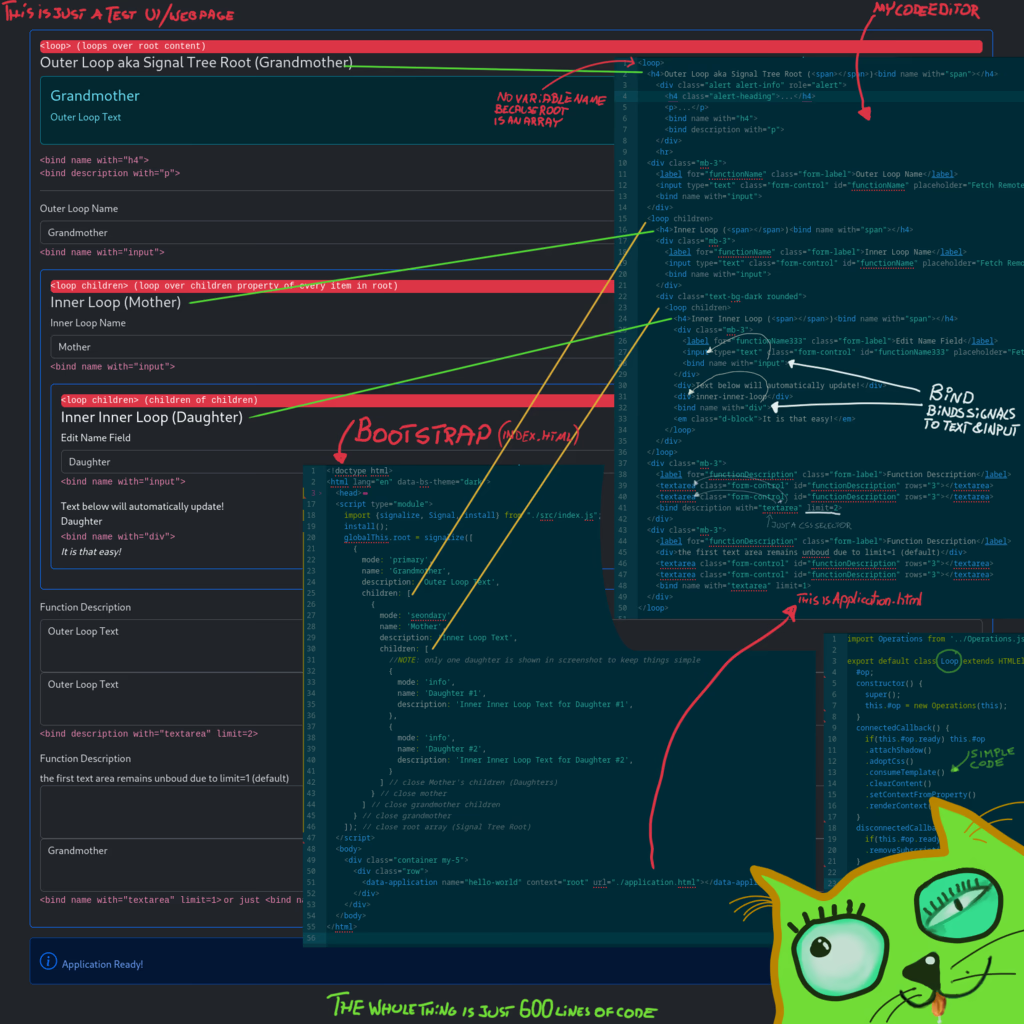
I grew up playing arcade games, learning early programming on machines like the Commodore 64 and Atari, and spent years mastering BASIC before developing my own projects; recently I built a lightweight Svelte-like framework using Web Components that achieves bi‑directional data binding with minimal code, demonstrating how low‑level components can simplify UI development and enable visual programming tools for end users.

Programming Teaches Like A Mother

The post describes how beginners can start learning JavaScript simply by watching video tutorials and exploring existing modules before moving on to writing their own. It highlights the usefulness of creating small helper libraries—such as the author’s “one‑of” module that picks a random element from an array—and encourages using established utilities like lodash for efficient coding. By repeatedly reconstructing familiar programs, developers can deepen their understanding, refine their style, and gain confidence, turning practice into mastery and ultimately producing elegant, powerful code that feels almost artistic.

Teachers, Stop Pretending To Teach

The author laments how teachers use GPA threats and rote memorization to control students, claiming this defeats the purpose of schools—to lift pupils up rather than keep them stuck in “bullies’” hands. He argues that true learning comes from doing real projects—programming from the start, building desktop apps, visualizing simulations—and from tackling authentic challenges such as hiking major trails while listening to great thinkers. By giving students hands‑on programming experience and encouraging them to create software that can bring in money, he believes they will leave school unscared, free of poverty, and ready to be dreamers, inventors, and creatives who inherit a culture of greatness rather than a mere graduation ceremony.

It Is Neither About The Journey Or Its Heights; It Is About Who You Become During Your Journey

The post argues that schooling can be seen as a quest where the real value lies in the journey of growth rather than reaching an end goal; it contrasts the “free pizza” metaphor with the effort of learning, citing high‑school’s focus on profit and memorization over true comprehension. It then likens true education to programming: you start at a base level, practice daily, build skills, and become a creator or “code wizard.” Finally, it cites long‑hike trails (the Appalachian, Pacific Crest, and Continental Divide) as an example of a transformative journey that takes years but ultimately shapes one into a wiser being.

Learn For Real; Or, Don't Get Tricked, Ineffective Education Is A Shortcut For Liars

The author argues that real schools should foster genuine understanding rather than rote memorization, pointing out how current schooling systems resemble machines that simply repeat facts (like “mitochondria is the powerhouse of the cell”) without encouraging true comprehension. They claim that this mechanical approach leaves students with a diploma but no real knowledge or creative ability, and they illustrate this by comparing it to music classes where spontaneous composition only occurs when learners are truly engaged. The essay concludes that self‑education—driven by curiosity, creativity, and disciplined practice in science, arts, and programming—is the key to becoming a well‑rounded individual capable of wisdom, dignity, and genius.

Learning Programming Is Easy, You Just Have To Put Your Foot In The Door

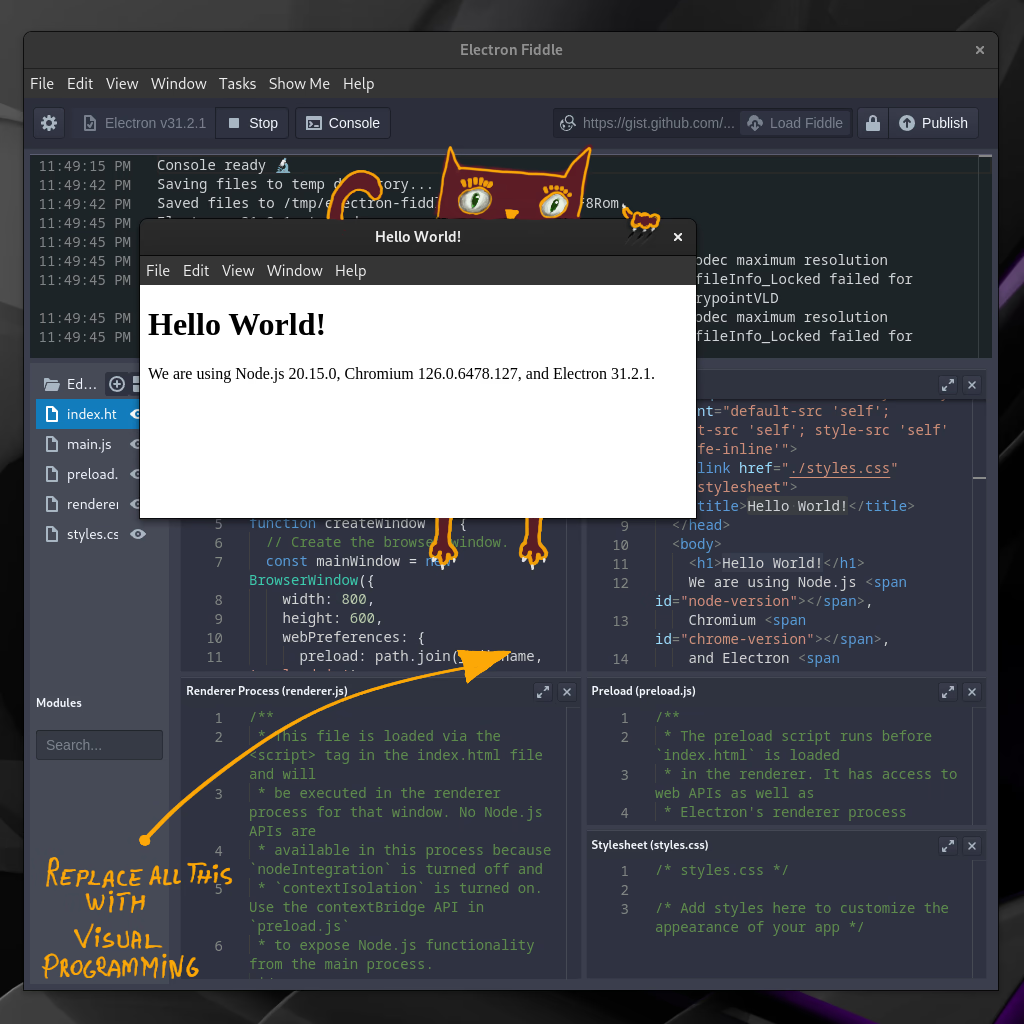
The author opens by declaring a single‑language focus and then walks through the very first steps of learning JavaScript: writing a “Hello World” in the console with `console.log`, executing it in Chrome’s DevTools, and then moving on to richer tutorials. They recommend starting with practical projects such as an Electron Fiddle desktop app, then exploring p5.js for creative graphics, and finally adding Node/Express or NativeScript for more complex applications. Alongside these tutorials they suggest browsing JavaScript libraries, awesome lists, and Git repositories, while favoring lightweight editors like Pulsar or zed over Visual Studio Code. The post emphasizes hands‑on practice, planning with paper diagrams for larger projects, and watching tutorial videos until something clicks. Finally it stresses that mastering programming is a powerful multiplier skill—much like language, reading, or math—and can elevate any other interest when applied through automation, simulation, visualization, or AI scripting.

Integrate Your Future; Or, Stand Up For Effective Education

The post argues that schools and teachers perform rather than truly teach; they focus on memorization for tests, which erodes authentic learning and mirrors how some religious institutions fake education for their congregations. The author claims this loss of organic knowledge turns students into fools whose futures become disintegrated unless they actively integrate learning through hands‑on projects—such as programming, 3D modeling, or music composition—to build a lasting legacy of authentic, profound education.

Creators, Navigators, And Saving The World

Today’s post argues that modern AI is far more capable than we often think and can be harnessed through mind‑mapping tools to break big tasks into small, automatable steps—whether it’s writing code or generating new ideas. By building a program that lets the AI extend and refine concept maps, developers can hand off most of the creative work while still controlling the process. The author suggests launching such an AI‑assisted mind‑map app as the first revenue stream: give users free credits, then sell additional ones or monthly upgrades when they hit limits. Next, he proposes turning these tools into full desktop “school” applications (electron/nexe) that let learners build knowledge trees with notebooks, simulations, and interactive visualisations—AI filling in missing content on demand. In short, the idea is to use AI‑generated concept maps as both a productivity engine for developers and an adaptive, game‑like learning platform for students.

You Are A Creature Of The Stars

A unique, Earth-bound being born by chance seeks to grow into a wise “great being” through education, adventure, and books, while overcoming poverty’s constraints that limit learning; war is seen as a crime against humanity that only an educated people can prevent, and this cycle of mistakes and cascading consequences can be fixed if knowledge is fact‑based, functional, and meaningful—so the post urges us to follow the philosophical thread begun by thinkers like Socrates, who challenged conventional wisdom, practiced self‑knowledge, and used dialogue to pursue virtue, thereby inspiring each individual to become a teacher, leader, and independent consciousness that can change the world.

Programmers! Don't Just Use Plain Variables, Oh No!

In this post the author explains how to replace simple variable assignments with reactive “Signal” objects in web applications: a Signal has get/set/subscribe methods so that when its value changes all subscribers are notified automatically. They then describe extending this idea into a signal tree—an ordinary JavaScript object whose properties (including a children array) are turned into Signals, allowing nested state to propagate through the UI via custom web components such as <loop> and <bind>. In short, server‑driven or user‑input data is inserted once into the tree, and any bound UI element updates automatically whenever that data changes.

Bushwhacking In America

I’ve spent an entire year trying to make sense of the wild creatures that share my neighborhood and it’s been a comic tour from squirrels to skunks, bats and deer. The post opens with the author lamenting how bushwhacking in America feels unprepared for, and then goes on to describe feeding peanuts to local squirrels—only to find them still “beneath” him and never quite convinced of his friendliness. He follows that with a brief but vivid sketch of skunks: at night they spray from their rear ends when approached, and the author notes how even a flashlight won’t keep them away. The narrative then jumps to bats that fly in circles and stick to heads—hence the joke about hats in Texas—and finally to deer who have visited after he dropped a fig, treating him like a “scantly dressed plump man” with a rock in hand. Throughout, his encounters illustrate how these animals view humans as nuisances or threats rather than companions, and that even simple gestures of feeding can be misread by the wildlife around him.

The Future Is Always Bright, Once You Learn Programming

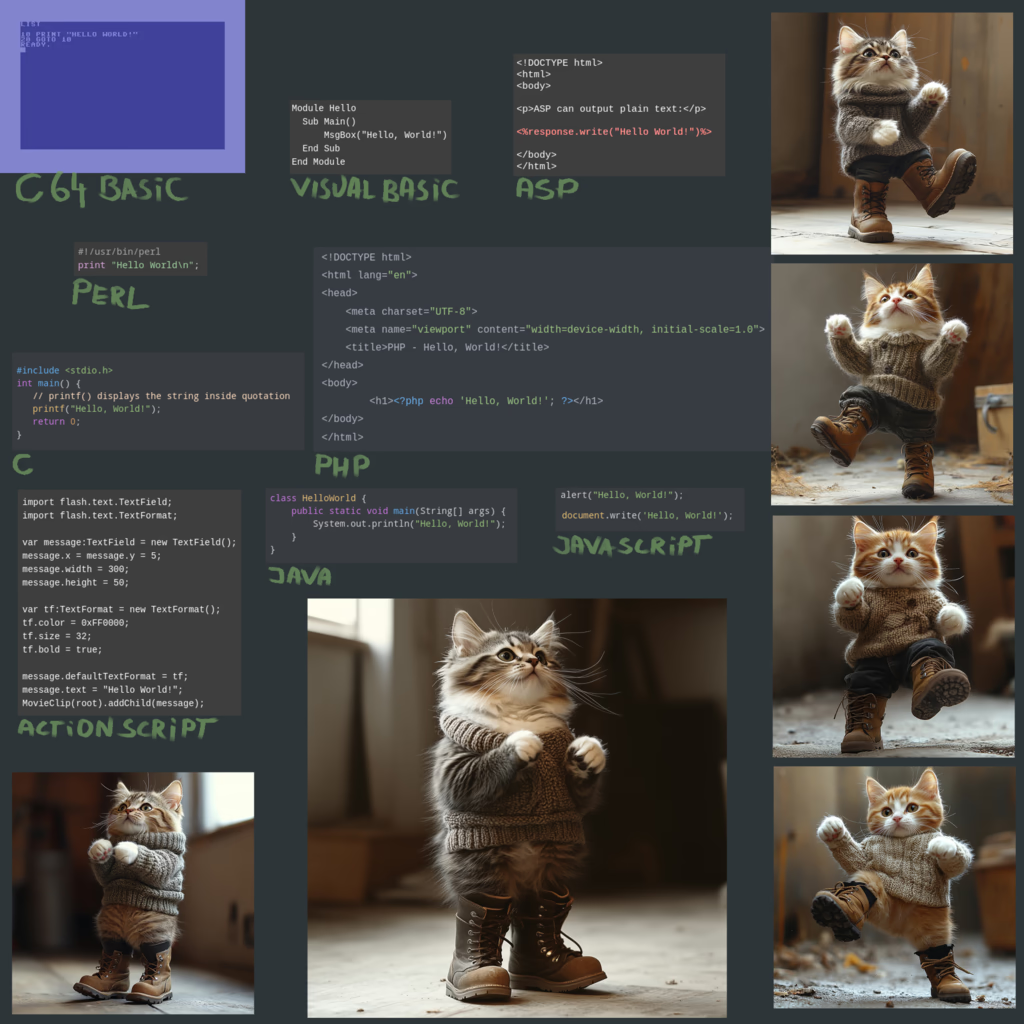
The author recounts their journey through programming languages—starting with ActionScript to solve early browser quirks, then shifting to JavaScript when Node.js enabled server‑side scripting; they note how PHP and Perl fell behind while JavaScript gained dominance. They touch on learning other languages (Python, Rust, C/C++), remarking that each offers its own strengths, but JavaScript’s ubiquity remains key. The post also reflects on object‑oriented design in Java versus the more lightweight approach of JavaScript, and concludes with a practical suggestion: use Electron Fiddle to build a simple desktop environment (taskbar, windows, apps) as a learning exercise for combining HTML/CSS/JS into a cohesive UI.

Bodybuilding Explained Freaky Fast

The post proposes a simple yet intense workout routine that couples a trail‑mix protein diet with a high‑volume, one‑hour dumbbell session using progressively heavier weights (starting at 2 lb per hand and increasing by 2–3 lb as endurance improves). It stresses continuous movement for an hour or more, minimal rest, and syncing the exercise to music beats so that each lift stays in rhythm. The author argues that this long‑duration, low‑weight approach builds stamina, strengthens the entire body, burns fat, and prevents injury while avoiding the “heavy‑lift” plateau; it also claims that consistent effort over time will make you look younger and feel fitter, as long training can be done safely if the weight is increased gradually.

When Control Takes A Toll – A Back To School Special

A high‑school teacher explained how students are often prompted to enter their full e‑mail address, and the author humorously coined the term “Obedience Sickness” while reflecting on the routine of teachers, administrators, and students. The post describes teachers’ good ideas for engaging learners being stifled by budget limits, the use of MP3 players as a token reward, and how cramming and GPA pressure create an atmosphere where real learning is lost. The author argues that standardized education is failing because it relies on obedience rather than curiosity, and suggests that AI‑driven individualized instruction—especially through programming projects—could restore integrated, exploratory learning that truly engages students’ interests.

Fitness Is Sacred, Fitness Is Life

The post describes how today’s gyms are often well‑furnished yet lack true “wisdom” in training, leading many people to fall into common myths such as heavy lifting to failure or relying on schoolbook formulas that ignore individual differences. It argues that a better approach is an incremental, high‑volume, low‑weight routine—starting with a non‑stop hour of walking or light dumbbell work in parks or nature and using interval timers to gradually extend exercise time while shortening rests—before progressing to heavier weights for muscle building; this method builds endurance safely, avoids the injury risks of ego‑heavy lifting, and yields long‑term gains that can be achieved in a year with moderate effort rather than months of heavy sets. The author stresses that trainers must share this wisdom so people, especially larger or older individuals, can begin their fitness journey in parks and gradually move into gyms without confusing myths.

Listen To Philosophy Books And Practice Programming

The author argues that modern schooling is largely indoctrination—students learn useless facts and are rewarded for regurgitation rather than genuine understanding—driven by profit motives and a standardized system that keeps poverty and mediocrity alive. He proposes a shift to individualized, integrated learning: first mastering programming so learners can visualize and simulate concepts, then enriching their minds through extensive reading (10 000+ books) and real‑world experiences like hiking the Triple Crown. By combining hands‑on coding, immersive literature, and outdoor adventure, he believes people will become truly independent thinkers who leave a lasting legacy of human advancement.

So You Have Learned Programming... What Do?

Electron is a lightweight framework that lets developers build desktop applications using web technologies—just launching a browser window that runs HTML, CSS and JavaScript locally on the user’s machine, eliminating the need for server-side infrastructure; by creating simple browsers and an application‑oriented OS in Electron you can quickly prototype tools, generate code, and bundle standalone apps that run entirely offline, while still enjoying the power of web APIs and signal‑based data binding to simplify UI rendering—making desktop apps both inexpensive to host and easy to distribute via secure payment gateways.

Learn Programming First! Don’t Let Ghouls And Ineffective Education Trick You Out Of Your Future

The post celebrates the power of self‑directed learning and coding as a path to future success, urging readers to rise above traditional schooling, memorization, and the fear some “ghouls” (old thinkers) feel toward new technologies. It claims that AI will replace programmers only if they let it; by mastering programming on their own terms—creating custom functions, loops, objects, reactive UI, and browser apps—the reader can outpace those who cling to outdated methods. The poem invites the audience to build on giants’ shoulders, keep learning “functional knowledge,” and grow until becoming a great being in this future‑oriented world of innovation.

Gentile Dedys

The post argues that true mastery comes from sustained practice and genuine understanding rather than last‑minute cramming; it proposes replacing traditional high‑school curricula with “programming schools” where students build projects that simulate and visualize complex systems—physics, chemistry, biology, even astrophysics—and then use those skills to create applications or art tools. By learning programming in this hands‑on way, students can apply knowledge across disciplines, avoid the superficiality of rote memorization (e.g., “mitochondria is the powerhouse”), and gain authentic dignity that fuels creativity and lifelong learning. The author stresses that authenticity, coupled with disciplined practice, transforms a student into a genuine “gentleman” or “knight” in the intellectual sense—someone who continually builds on past deeds rather than relying on fleeting accolades.

Fitness Above All; Before You Take Care Of Others, You Must Take Care Of Yourself

The post argues that the hardest part of getting healthy is breaking old habits, and that long‑distance hiking offers a more effective routine than just hitting the gym. It claims that adventure not only gives life but also heals faster—nature’s beauty keeps you motivated while the gym feels confined to “four walls.” By committing to trails like the Appalachian or Pacific Crest for months of preparation, you’ll break obesity and repair over‑work fatigue in a way that supports others, celebrates each step, and ultimately strengthens your body quickly. In short, choosing extended outdoor adventures is presented as the true duty of survival and personal fitness, rather than merely a gym choice.

Don't Lift Heavy At The Gym: Scientific Evidence For High-Intensity, Multi-Hour Training With Low Weights

Studies show that muscle hypertrophy can be achieved with light weights as long as the training volume is sufficiently high, with research from Schoenfeld (2016) and Krieger (2010) confirming similar gains to heavy‑weight protocols when volume is matched. Muscle growth is driven by tension, metabolic stress, and damage; low‑repetition, high‑rep schemes generate significant metabolic stress and fatigue that stimulate hypertrophy, a concept supported by further work from Schoenfeld and others. Evidence also indicates that high‑volume training improves endurance, insulin sensitivity, and recovery, all of which can enhance muscle development. Practical examples demonstrate that many bodybuilders use low‑weight, high‑rep routines successfully, and the author emphasizes this approach while encouraging gradual progress, consistency, and enjoyment in training, concluding that light loads with sustained volume can be an effective path to muscular growth.

Gym Advice: Lifting Heavy Is A Mistake That Can Only Slow You Down

Training soldiers with light weights and extended sets improves endurance, prevents plateaus, and promotes functional full‑body coordination; by gradually increasing load in small increments while keeping tempo high you keep muscles moving continuously, reduce injury risk, and stimulate adaptation. Incorporating music to set pace, rotating between exercises, and maintaining a consistent routine of long, light sessions yields better results than sporadic heavy lifts. A balanced diet such as soaked trail‑mix also supports recovery.

The Seagull Diet; Or, What Really Happened On The Day I Learned To Love The Michigan Seagull

I grew up exploring the map of Michigan as a child, dreaming of future adventures by throwing darts at its outline—one dart landed just west of Detroit—and later venturing to Florida before returning once more to the Lake Michigan shore. The trip that mattered most was to Ludington State Park, where I fell in love with seagulls after feeding them trail‑mix and cheese puffs under a “Do not feed” sign; I’d even consider myself a sort of god‑grandfather to their flock because of my regular visits. One memorable afternoon I watched teenagers dig a hole, stack driftwood into a makeshift pole and fill the sides, effectively building a structure that would stay on the beach for years; another day a mother and her little daughter fed a gull so loudly it echoed across the sand, an event I still remember vividly. These encounters—my feeding routine, the teens’ construction, the family’s snack‑sharing—all cemented my bond with the birds and left me with lasting memories of that Michigan coast.

Codename Mephistopheles; Or, How Computer Programming Changes Everything

Mephistopheles is a visual programming language built on a signal‑tree architecture that uses Web Components and a box‑and‑cable interface to let users—especially young developers—to create UI kits, website templates, and full applications with minimal code. By binding loops, prints, and other logic to signals, the system automatically updates DOM attributes and supports recursive nesting of custom elements, while AI assists in generating both code and images. The author envisions a marketplace for these components (akin to Envato or WrapBootstrap) and a simple framework that rivals heavier tools like Svelte or Angular, all driven by minimalism and simplicity.