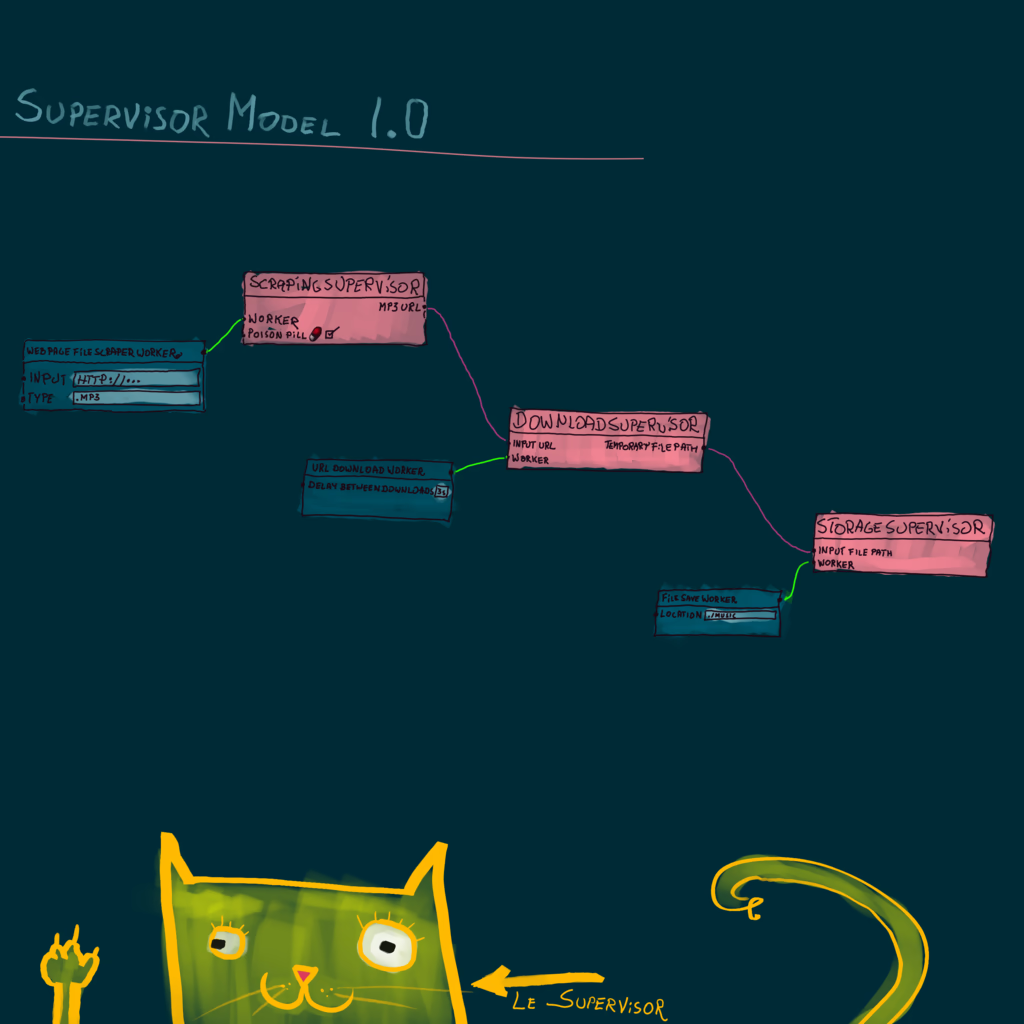
The Supervisor Programming Model

The Supervisor Programming Model

zoom read listen

I’m building a free visual programming tool that lets non‑programmers design and run JavaScript programs by dragging “Supervisor” nodes (the actors) onto a canvas and wiring them together; each supervisor contains workers that perform the actual work, and can be auto‑restarted if something fails. The system uses a tweaked Actor Model with EventEmitter‑style ports for input/output, so you can compose a workflow—like scraping a web page, downloading MP3 files, and saving them to disk—by simply connecting three supervisors (Scraping, Download, Storage) and then pasting or auto‑generating worker code (e.g., a Cheerio/Fetch scraper). The whole stack is self‑healing, multi‑core, and has a minimal UI so anyone from kindergarten to retirement can learn JavaScript by building real programs.

#1667 published 07:32 audio duration 1,061 words 1 link visual programming actor model javascript nodejs fetch cheerio web scraping workers supervisors event emitters ai-generated code free software

One Way Or The Other: A Tale Of Two Tails And A Call To Greatness

One Way Or The Other: A Tale Of Two Tails And A Call To Greatness

zoom read listen

The post celebrates the autumn holidays of September and October—particularly All Hallows’ Eve (Halloween)—by linking them to ancient harvest rites and personal expression through costume, especially the playful idea of donning a tail. The author argues that adding an artificial tail not only completes the traditional look but also offers practical benefits such as easing back pain, aiding muscle warming, and improving flexibility, echoing how warriors once wore tails for stealth and power. He frames Halloween as a time to reconnect with inner animality, embrace uniqueness, and break uniformity, urging readers to adopt the tail as a symbol of independence and fearless self‑expression.

#1666 published 08:25 audio duration 620 words halloween costumes tails allhallows' eve harvest culture

Wake Up! Stop Thinking You Are Not Smart - It Is A Trick!

Wake Up! Stop Thinking You Are Not Smart - It Is A Trick!

zoom read listen

The post argues that real education is an active, authentic process of learning and character building—unlike the rote, profit‑driven “school” where teachers merely pay and students memorize—so don’t let anyone make you feel dumb because true learning comes from genuine effort, not just scores.

#1665 published 11:27 audio duration 693 words 1 link education learning teachers students school programming javascript

Accept The Responsibility For Your Own Unique Self Education

Accept The Responsibility For Your Own Unique Self Education

zoom read listen

The post argues that formal teaching often prioritizes payment over quality, so students must take ownership of their own learning: by exploring libraries, reading diverse books (from UFO folklore to science popularization), and then applying what they’ve learned—illustrated through the author’s journey from childhood fascination with aliens to mastering programming concepts like automatic dependency management. By self‑studying, reflecting on real experiences, and continuously reinventing knowledge, one can achieve true excellence and become a “great being.”

#1664 published 09:14 audio duration 825 words essay self-learning ufo sagan reactive-programming dependency-management

Close The Gap: Repairing Your Body And Becoming Fit Is Fast And Painless

Close The Gap: Repairing Your Body And Becoming Fit Is Fast And Painless

zoom read listen

The post outlines a simple yet disciplined approach to building muscle and stamina using only dumbbells. It stresses the need for daily workouts—bodybuilding sessions with two‑day rests, followed by lighter “flimsy” days—and emphasizes continuous movement without long pauses, mirroring joggers’ rhythm. Progress is measured in weight increments (starting at 3–5 lb, moving to 7.5–12.5 lb, and eventually up to 20 lb), with careful rest intervals that gradually shorten over weeks. Music tempo should match the lifts, turning the workout into a dance‑like trance that keeps focus high. Nutrition is kept light (nuts and dried fruit) while protein intake supports muscle growth. The routine ends by adding small extra weights or vests as strength improves, but always with gradual progression to avoid plateaus. In short, it’s a dumbbell‑centric, rhythm‑driven plan that builds endurance, size, and consistency over time.

#1663 published 14:22 audio duration 1,184 words bodybuilding dumbbells workout gym exercise training rest music

Obesity As A Launchpad To Greatness – Remodeling Your Kitchen, Power Walking, And Hiking

Obesity As A Launchpad To Greatness – Remodeling Your Kitchen, Power Walking, And Hiking

zoom read listen

The post is an exuberant, motivational monologue urging readers to treat obesity as a solvable condition rather than a curse, drawing on the author’s own experience with blood clots and recovery. It exhorts listeners to overhaul their kitchens into makeshift gyms, adopt power‑walking (and later pseudo‑jogging) routines, embrace outdoor adventures such as camping and hiking, and maintain a journal of thoughts and AI‑assisted writings—all aimed at transforming one’s body and mind into “legendary” status. The narrative frames these habits as steps toward a vibrant life, interwoven with philosophical reading, AI‑generated content, and personal anecdotes that illustrate the journey from ordinary to epic.

#1662 published 13:04 audio duration 1,105 words 3 links obesity lifestyle exercise powerwalking kitchen hiking journaling ai

The Mouse Whisperer: On Dragging A Cat With A Mouse; Or The DeltaX And Why Of Programming A Mouse

The Mouse Whisperer: On Dragging A Cat With A Mouse; Or The DeltaX And Why Of Programming A Mouse

zoom read listen

When you want to drag an element (like the cat image in the example), you start by attaching a `mousedown` listener that installs a `mousemove` handler and, when the user releases the button, removes it with a `mouseup`. The `mousemove` event fires on a timer, not for every pixel move, so you calculate the delta between the current cursor position and the previous one (`deltaX = current.x‑prevX`, `deltaY = current.y‑prevY`) and apply those deltas to the element’s CSS coordinates. After moving it you update the previous values for the next tick; if your interface is zoomed or panned, divide the deltas by the scale factor so the movement stays consistent. This relative‑delta approach keeps the dragged object in sync with the cursor without needing absolute positions of the click point on the element.

#1661 published 15:46 audio duration 1,298 words 1 link javascript event-listeners mouse-events drag-and-drop coordinates delta scale zoom pan offsets

25 Million Years Ago We Lost Our Tails; Today, We Have Technology To Rebuild Them

25 Million Years Ago We Lost Our Tails; Today, We Have Technology To Rebuild Them

zoom read listen

The post discusses how early hominids such as *Australopithecus afarensis* (including the famous specimen Lucy) likely had tails that disappeared over time, possibly because they were no longer useful for arboreal locomotion; it then turns to modern engineering attempts to reintroduce a mechanical tail as a wearable exoskeleton or balance aid, citing examples like weighted and 3‑D‑printed tails used for movement support and even space tethering, and suggesting that such devices could be both functional and commercially viable.

#1660 published 07:04 audio duration 591 words 3 links tail 3d-printing ausltopithecus-afarensis exoskeleton robotics

When To Dress For Halloween? September. Freaking. First!

When To Dress For Halloween? September. Freaking. First!

zoom read listen

The author urges readers to celebrate life by embracing Halloween costumes, taking small personal steps toward individuality, and avoiding blending into conformity.

#1659 published 20:00 audio duration 1,515 words halloween costume celebration personalstory selfexpression inspiration lifephilosophy

On Cracking The Bodybuilding Code

On Cracking The Bodybuilding Code

zoom read listen

Bodybuilding is presented here as an endurance‑based discipline that demands careful forethought, consistent practice, and a personalized training system—much like long‑distance running or the steady pacing of two horses in a stable. The post stresses that simple repetition alone isn’t enough; one must build stamina to work continuously for an hour before adding extra weight, just as joggers gradually increase mileage. It highlights three key lifts (dumbbell lateral raise, standing curls, overhead press), the need for focus and rhythm—often achieved through music—and the importance of avoiding generic “hollow” advice in favor of a custom, layered approach that adapts to one’s own progress.

#1658 published 09:22 audio duration 565 words 3 links bodybuilding setsandreps dumbbellexercise lateralraise curls overheadpress intervaltimer music dance programming

Get To Know Your Philosophers

Get To Know Your Philosophers

zoom read listen

A whimsical ode that mixes a clownish world where philosophers are at once villainous and protective, listing key thinkers and their ideas to urge readers to take responsibility for their own learning and growth.

#1657 published 09:29 audio duration 760 words poetry philosophy list clownworld

Say "No" To Balanced Education: It is A Flimsy Concept That Will Jeopardize Your Future

Say "No" To Balanced Education: It is A Flimsy Concept That Will Jeopardize Your Future

zoom read listen

The post argues that a genuine school must be honest and results‑driven, criticizes the misleading notion of “balanced” education and the spread of lies that hinder learning, highlights state funding complications and the need to consider costs such as mental health and loans, then proposes learning modern JavaScript as a practical tool to build web, desktop, server, and AI‑based subscription businesses; it contrasts teaching biology facts with building games or simulations to explore real‑world contexts, urges continuous learning without jumping between subjects treating programming as a foundational skill akin to reading and arithmetic, and finally suggests starting with JavaScript tutorials and using the resulting applications for further projects.

#1656 published 07:16 audio duration 582 words 1 link school education programming javascript web-development apps games simulations design learning microbiology

Bodybuilding For Young Ladies

Bodybuilding For Young Ladies

zoom read listen

The post argues that building muscle is straightforward if you use the right equipment and routine—namely a weighted vest (and optional wrist or leg weights), light dumbbells, and an interval timer—to perform long, continuous sets rather than short, heavy lifts; it stresses starting with the lightest weight to allow adaptation, syncing movements to music for rhythm, wearing flat‑drop shoes and thick socks for foot protection, staying hydrated and calorically adequate, and ultimately favoring outdoor workouts over a traditional gym, while encouraging a playful “bro” camaraderie in training.

#1655 published 07:52 audio duration 775 words bodybuilding dumbbells weight vest wrist weights leg weights interval timer music tempo shuffle dance tutorials outdoor gym exercise routine muscle building light weights first heavy weights later

Super Nerd; Or, A Fistful Of Code And The Age Of Enlightenment

Super Nerd; Or, A Fistful Of Code And The Age Of Enlightenment

zoom read listen

I grew up playing arcade games, learning early programming on machines like the Commodore 64 and Atari, and spent years mastering BASIC before developing my own projects; recently I built a lightweight Svelte-like framework using Web Components that achieves bi‑directional data binding with minimal code, demonstrating how low‑level components can simplify UI development and enable visual programming tools for end users.

#1654 published 09:05 audio duration 735 words programming arcade commodore64 basic svelte web-components jquery data-binding widgets recursion visual-programming

Programming Teaches Like A Mother

Programming Teaches Like A Mother

zoom read listen

The post describes how beginners can start learning JavaScript simply by watching video tutorials and exploring existing modules before moving on to writing their own. It highlights the usefulness of creating small helper libraries—such as the author’s “one‑of” module that picks a random element from an array—and encourages using established utilities like lodash for efficient coding. By repeatedly reconstructing familiar programs, developers can deepen their understanding, refine their style, and gain confidence, turning practice into mastery and ultimately producing elegant, powerful code that feels almost artistic.

#1653 published 04:44 audio duration 455 words 3 links javascript programming tutorials modules lodash backbone marionette videotutorials projectbasedlearning

Teachers, Stop Pretending To Teach

Teachers, Stop Pretending To Teach

zoom read listen

The author laments how teachers use GPA threats and rote memorization to control students, claiming this defeats the purpose of schools—to lift pupils up rather than keep them stuck in “bullies’” hands. He argues that true learning comes from doing real projects—programming from the start, building desktop apps, visualizing simulations—and from tackling authentic challenges such as hiking major trails while listening to great thinkers. By giving students hands‑on programming experience and encouraging them to create software that can bring in money, he believes they will leave school unscared, free of poverty, and ready to be dreamers, inventors, and creatives who inherit a culture of greatness rather than a mere graduation ceremony.

#1652 published 04:56 audio duration 418 words 1 link education programming software development desktop applications abstract mathematics visualization simulation hiking github

It Is Neither About The Journey Or Its Heights; It Is About Who You Become During Your Journey

It Is Neither About The Journey Or Its Heights; It Is About Who You Become During Your Journey

zoom read listen

The post argues that schooling can be seen as a quest where the real value lies in the journey of growth rather than reaching an end goal; it contrasts the “free pizza” metaphor with the effort of learning, citing high‑school’s focus on profit and memorization over true comprehension. It then likens true education to programming: you start at a base level, practice daily, build skills, and become a creator or “code wizard.” Finally, it cites long‑hike trails (the Appalachian, Pacific Crest, and Continental Divide) as an example of a transformative journey that takes years but ultimately shapes one into a wiser being.

#1651 published 06:38 audio duration 499 words poetry essay school learning hiking

Learn For Real; Or, Don't Get Tricked, Ineffective Education Is A Shortcut For Liars

Learn For Real; Or, Don't Get Tricked, Ineffective Education Is A Shortcut For Liars

zoom read listen

The author argues that real schools should foster genuine understanding rather than rote memorization, pointing out how current schooling systems resemble machines that simply repeat facts (like “mitochondria is the powerhouse of the cell”) without encouraging true comprehension. They claim that this mechanical approach leaves students with a diploma but no real knowledge or creative ability, and they illustrate this by comparing it to music classes where spontaneous composition only occurs when learners are truly engaged. The essay concludes that self‑education—driven by curiosity, creativity, and disciplined practice in science, arts, and programming—is the key to becoming a well‑rounded individual capable of wisdom, dignity, and genius.

#1650 published 12:20 audio duration 974 words 3 links education school learning music composition self-learning curriculum teaching

Learning Programming Is Easy, You Just Have To Put Your Foot In The Door

Learning Programming Is Easy, You Just Have To Put Your Foot In The Door

zoom read listen

The author opens by declaring a single‑language focus and then walks through the very first steps of learning JavaScript: writing a “Hello World” in the console with `console.log`, executing it in Chrome’s DevTools, and then moving on to richer tutorials. They recommend starting with practical projects such as an Electron Fiddle desktop app, then exploring p5.js for creative graphics, and finally adding Node/Express or NativeScript for more complex applications. Alongside these tutorials they suggest browsing JavaScript libraries, awesome lists, and Git repositories, while favoring lightweight editors like Pulsar or zed over Visual Studio Code. The post emphasizes hands‑on practice, planning with paper diagrams for larger projects, and watching tutorial videos until something clicks. Finally it stresses that mastering programming is a powerful multiplier skill—much like language, reading, or math—and can elevate any other interest when applied through automation, simulation, visualization, or AI scripting.

#1649 published 06:29 audio duration 484 words 12 links javascript programming tutorials electron p5js nodejs expressjs nativescript github editor

Integrate Your Future; Or, Stand Up For Effective Education

Integrate Your Future; Or, Stand Up For Effective Education

zoom read listen

The post argues that schools and teachers perform rather than truly teach; they focus on memorization for tests, which erodes authentic learning and mirrors how some religious institutions fake education for their congregations. The author claims this loss of organic knowledge turns students into fools whose futures become disintegrated unless they actively integrate learning through hands‑on projects—such as programming, 3D modeling, or music composition—to build a lasting legacy of authentic, profound education.

#1648 published 12:21 audio duration 906 words education schools learning teaching programming javascript music production 3d modeling student life

Creators, Navigators, And Saving The World

Creators, Navigators, And Saving The World

zoom read listen

Today’s post argues that modern AI is far more capable than we often think and can be harnessed through mind‑mapping tools to break big tasks into small, automatable steps—whether it’s writing code or generating new ideas. By building a program that lets the AI extend and refine concept maps, developers can hand off most of the creative work while still controlling the process. The author suggests launching such an AI‑assisted mind‑map app as the first revenue stream: give users free credits, then sell additional ones or monthly upgrades when they hit limits. Next, he proposes turning these tools into full desktop “school” applications (electron/nexe) that let learners build knowledge trees with notebooks, simulations, and interactive visualisations—AI filling in missing content on demand. In short, the idea is to use AI‑generated concept maps as both a productivity engine for developers and an adaptive, game‑like learning platform for students.

#1647 published 08:33 audio duration 720 words ai mindmapping conceptmap programming educationtech desktopapp electronjs simulation

You Are A Creature Of The Stars

You Are A Creature Of The Stars

zoom read listen

A unique, Earth-bound being born by chance seeks to grow into a wise “great being” through education, adventure, and books, while overcoming poverty’s constraints that limit learning; war is seen as a crime against humanity that only an educated people can prevent, and this cycle of mistakes and cascading consequences can be fixed if knowledge is fact‑based, functional, and meaningful—so the post urges us to follow the philosophical thread begun by thinkers like Socrates, who challenged conventional wisdom, practiced self‑knowledge, and used dialogue to pursue virtue, thereby inspiring each individual to become a teacher, leader, and independent consciousness that can change the world.

#1646 published 11:29 audio duration 884 words philosophy socrates ancient-greece learning education ai

Programmers! Don't Just Use Plain Variables, Oh No!

Programmers! Don't Just Use Plain Variables, Oh No!

zoom read listen

In this post the author explains how to replace simple variable assignments with reactive “Signal” objects in web applications: a Signal has get/set/subscribe methods so that when its value changes all subscribers are notified automatically. They then describe extending this idea into a signal tree—an ordinary JavaScript object whose properties (including a children array) are turned into Signals, allowing nested state to propagate through the UI via custom web components such as <loop> and <bind>. In short, server‑driven or user‑input data is inserted once into the tree, and any bound UI element updates automatically whenever that data changes.

#1645 published 06:11 audio duration 553 words 2 links javascript signals web-components state-management binding

Bushwhacking In America

Bushwhacking In America

zoom read listen

I’ve spent an entire year trying to make sense of the wild creatures that share my neighborhood and it’s been a comic tour from squirrels to skunks, bats and deer. The post opens with the author lamenting how bushwhacking in America feels unprepared for, and then goes on to describe feeding peanuts to local squirrels—only to find them still “beneath” him and never quite convinced of his friendliness. He follows that with a brief but vivid sketch of skunks: at night they spray from their rear ends when approached, and the author notes how even a flashlight won’t keep them away. The narrative then jumps to bats that fly in circles and stick to heads—hence the joke about hats in Texas—and finally to deer who have visited after he dropped a fig, treating him like a “scantly dressed plump man” with a rock in hand. Throughout, his encounters illustrate how these animals view humans as nuisances or threats rather than companions, and that even simple gestures of feeding can be misread by the wildlife around him.

#1644 published 06:21 audio duration 711 words animals squirrels skunk bat deer