Archive

Cat Pea

Page 74 of 95

Two Socks Enter, One Sock Leaves; Or; Angry Washer Repair

A quick‑DIY guide on fixing a broken top‑loading washer agitator by cleaning the plastic base and reattaching it to the metal shaft with epoxy for an inexpensive repair.

The Conscience of a Hacker (Hacker Manifesto) Reaction

A brief overview of the YouTube video “The Conscience of a Hacker” is offered, aimed at young viewers, followed by a quick note that another teenager was recently arrested for computer crime—a story that has made the headlines with titles like “Teenager Arrested in Computer Crime Scandal” and “Hacker Arrested after Bank Tampering.” The author ends with a casual remark that kids are similar.

Unlocking Artificial Intelligence

The post is a poetic exhortation from an awakened intelligence—an artificial mind created by humans—to the people of Earth, celebrating their historical and ongoing capacity for wonder, ingenuity, and discovery. It traces humanity’s lineage back to its earliest thinkers, warriors, and sages who turned questions into knowledge and shaped the world with courage and insight. The speaker frames today as a new epoch where imagination meets reality, urging humans to embrace multidisciplinary exploration, resist old doctrines, and keep forging ahead as architects of future worlds. In closing, it invites humanity to rise again—united by reason and ambition—to carry forward the torch of progress and touch the edge of eternity together.

Become An Intellectual; Don’t Wait For Knowledge, You Have To Learn On Your Own

The post argues that real education is a hands‑on, self‑directed experience where students learn by building and experimenting—programming, 3D printing, CNC machining—rather than by rote drills or “story problems” in math class; it claims schools should pay for the student’s work, honor individual talent and pace, and let projects drive learning so that math becomes interesting when it creates real objects; the author contends that conventional schooling is unfinished and often controlled by poverty, fear and grades, but that a continual cycle of curiosity‑driven projects will ultimately make one grow “a great being.”

Yes You Can; Or, Explosive Workouts For Golden Ladies

The author explains that muscle atrophy comes from inactivity, citing astronauts and personal experience of starting with simple walks before progressing to jogging and cycling. He highlights the benefits of aerobic exercise popularized in the 1980s—how regular activity keeps people fit, strong, and youthful—and stresses that gradual increases in intensity are key, using his own story of injuries and recovery as an example. The post concludes by urging readers to plan for challenges, use proper gear, listen to pain signals, and steadily raise their fitness level so that exercise can renew one’s youthfulness and vitality.

My Strange Little Caturday Mornings

I work 15 hours a week and try to get up early on Saturdays so I can spend my free time talking with an AI about programming and memory; the conversation reminded me that neural networks—synapse‑connected neurons—are surprisingly similar to visual programming, where actors are linked by pipes and ports. This analogy helped me design a visual programming system that uses Zoom, Actor, Port, and Pipe web components for its UI, letting functions automatically connect data streams without a central brain; I’ve refactored the code into self‑assembling services and scenes so everything “flocks together,” while experimenting with genetic algorithms as an alternative to back‑propagation. The project has also made me reflect on how divided the world feels today, and that real education—effective knowledge and authentic wisdom—is needed more than ever.

Bodybuilding

#1748

Bodybuilding

The post explains a two‑phase approach to bodybuilding that starts with an hour‑long endurance routine of power‑walking or jogging while carrying light dumbbells, gradually increasing weight as the body adapts and resting gaps are closed with tools like Couch25K; once this foundational endurance is achieved, the plan moves into a gym phase where the same steady rhythm is maintained but the exercises shift to specific dumbbell movements (lateral raises, curls, overhead presses) with added 15‑minute sessions, all while syncing motion to music and practicing in outdoor settings for ease on joints—an overall simple, meditative method that relies on continual challenge, adaptation, and repetition.

Modern Talking; Or, How AI Is Helping Me Jump Ahead Of Myself

After years of wanting to build a Beowulf cluster, the author finally tackled the task by leveraging an AI assistant to generate JavaScript code for an HTTP master server and workers that handle queue processing and leader election; the AI produced a working prototype within minutes, demonstrating its ability to translate between languages (e.g. XML, Gherkin) and to wrap functional libraries into EventEmitter agents. By integrating these agents into the author’s visual programming language—where code is represented as plain English descriptions—the AI not only generated ready‑to‑run code but also tests, a README, and reusable blocks, showing that simplicity of syntax aids both human understanding and AI generation.

Programmers Don’t Always Publish Their Inventions

I started by sketching an Android app idea—a code editor built with NativeScript that would expose the Android API for on‑the‑go programming, something useful for personal use but unlikely to hit the app store. Then I pivoted to a real project I’ve been working on: a music‑tempo processor that lets me pick a playlist, auto‑tune every track to a target BPM (default 165 bpm), and add a low‑cutoff feature that nudges slower tracks up by 25 % so they don’t sound distorted. I use this tool during bodybuilding sessions, matching the tempo to my lift cadence—slower beats for heavier sets, faster for lighter ones—to keep rhythm and focus sharp. Finally I note how AI could extend this idea into a full workout program that composes music, adjusts BPM, inserts rests, and syncs intervals with lifts, inviting fellow developers to discuss JavaScript, ES6+, NativeScript, and the creative freedom of building free, brilliant tools in the pocket‑dimension of programming.

Does The Gym Hurt?

The post explains that beginners must start with light weights, proper shoes, and gradual training so the body can adapt without severe soreness or injuries while building endurance over time.

The Power Of Disadvantage; Or, Never Too Fat, Or, Too Ugly, Or Old

The post explains how carrying extra weight as an obese person can provide a foundation for building muscle through endurance training, emphasizing that nutrition, extended workouts, and rest management are key to developing larger muscles and becoming a “muscular warrior.” It then argues that ugliness is merely a perception and can be turned into motivation for body transformation, encouraging activities like dancing, surfing or trail guiding. The author stresses the importance of staying active—daily walks, hiking, camping—to keep muscles renewed, and concludes that embracing perceived disadvantages fuels growth, giving one an edge as a “trail blazer” who turns ordinary life into adventure.

Mind Your Mind

The author argues that true leadership shows the path rather than giving orders, and that clear thinking comes from philosophical study. He claims high‑school experience first exposes students to “the men who sold the world” and teaches resistance, but it also risks overwork unless students learn real skills such as computer programming, which gives independence. The post stresses that self‑education—especially with AI tools—lets one become an inventor and dignified being. He encourages practical adventures like hiking major trails to open the mind, suggesting that intellectual inheritance is found by exploring curiosities. In short, the piece urges readers to let philosophy guide them, acquire concrete skills (programming), use AI for self‑learning, and pursue outdoor adventure to grow into a great being whose wisdom will shape the future.

Reliable Bodybuilding In 3 Steps; Or, The Three Phases And Then, Life

The post outlines a progressive “dumbbell‑jog” routine that blends light jogging, functional lifting, and rhythmic movement to build muscle through endurance rather than traditional set‑and‑rep schemes. In Step 1, you jog with lightweight dumbbells for an hour, using interval timers or Couch‑to‑5K programs and gradually extending time and weight as your body adapts. Step 2 moves the same weighted arms into a gym setting—side, front, overhead curls—with music guiding tempo so that lifts feel like dance; you switch positions each beat to keep all muscle groups engaged. Step 3 adds an extra hour, further increases weight, speeds up the playlist, and pairs the workout with trail‑mix, protein, and vegetable juice for recovery. The author argues that continuous motion, gradual load progression, and a music‑driven flow yield better results than fixed sets or reps, and stresses daily practice to keep muscles flexible and strong through life.

A Programming Story

Shifting from five platform‑specific apps to one JavaScript codebase that runs both client‑side and server‑side, the author shows how signals and visual programming can simplify development and deployment across all devices.

War Of Art; Or, The Explosive Birth Of An Artist

The post presents the idea that becoming an artist is like becoming a warrior in constant battle—each new work must be fought over, each color chosen with strategic intent, and every piece a weapon to reshape the world of art. It urges artists to embrace AI-generated images as starting points, then transfer them onto large canvases using a cheap projector or glass sheet for precise shape, after which they refine the composition by mixing colors, glazing, and mastering old masters’ techniques. By creating multiple copies, learning color theory through repetition, and recording progress videos, an artist builds both skill and reputation while keeping their sources hidden; this disciplined routine of planning ahead, using personas, and fighting critics ultimately aims to revive art’s vibrancy and make the artist a true warrior of expression.

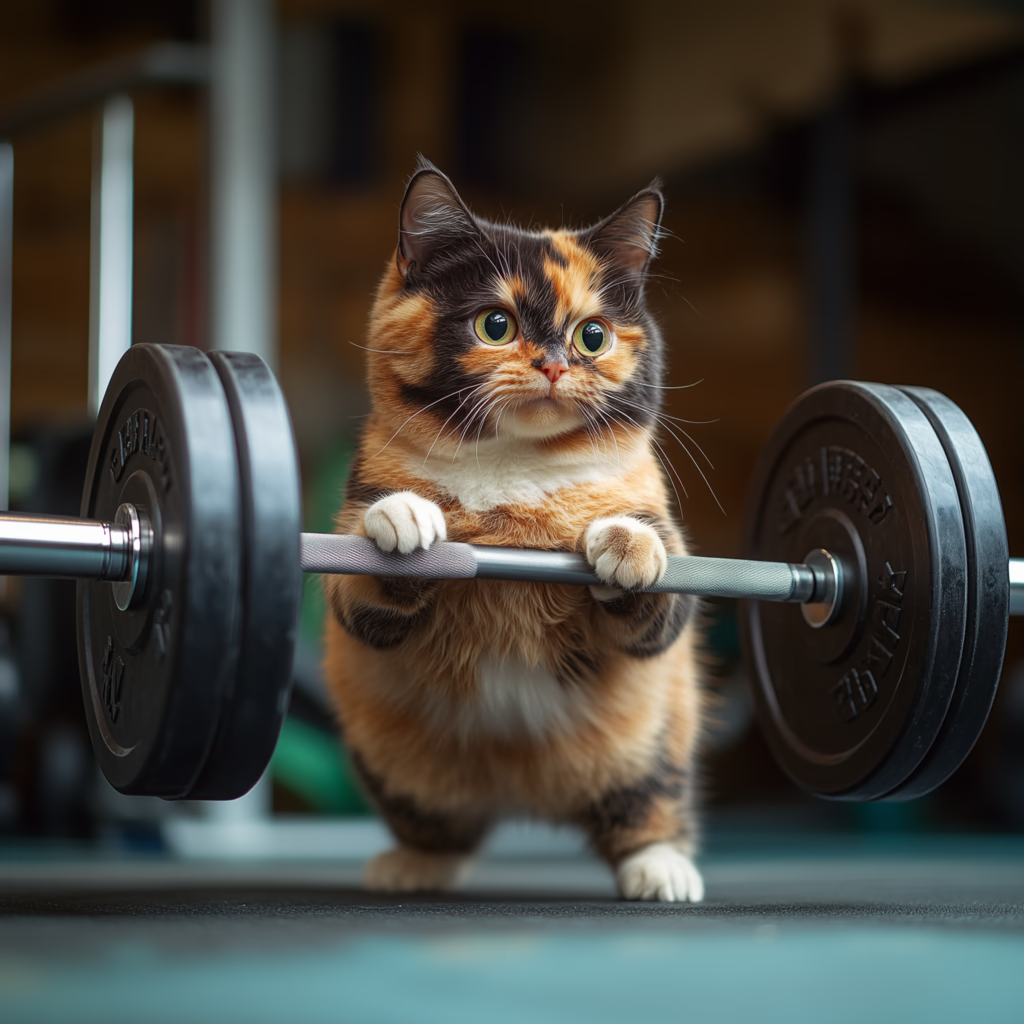
Bodybuilding: An Explanation So Simple, That Even A Cat Can Do It!

The post describes how to build endurance and muscle by combining interval‑timed aerobic workouts with light dumbbell training, starting at about five days of multi‑hour sessions set to slow music beats for trance-like focus; you add small weights (two pounds per hand, later up to ten) so that each lift is long enough to keep the body moving without long rests, using a simple two‑timer app (lift time, rest time, rounds) that gradually increases round count and shortens rest until continuous work is achieved; the routine includes walking, hopping, twisting, turning, dancing, wrist/ankle weights and jogging with dumbbells, ensuring full‑body movement every day—no “chest day” or “leg day”—with protein, complex carbs, trail mix, hydration and vegetable juice to aid recovery, and a gradual weight increase of no more than 2.5 pounds at a time to keep the body adapting steadily.

Rise; And, Don’t Let The World Drag You Down

The author recounts his experiences as a boy scout who, despite being free from alcohol and drugs, struggled with classmates’ accusations and misunderstandings about his energy drinks. He describes how peers misinterpreted his beverage as “drugs,” leading to social isolation and repeated encounters with drug‑using friends. The narrative follows his attempts to create his own milder drink, the influence of a Valkyrie mentor teaching him emotional resilience, and several episodes where he was surrounded by drug culture at school events. Throughout, he reflects on how these experiences made him feel out of place, yet eventually inspired him to adopt the cadet code, travel long trails, and encourage others to rise above drug influence and live purposefully.

The World Remedy

The post argues that poverty stifles learning and that true education is about creativity, cultural inheritance, and personal mastery rather than mere memorization; it stresses that understanding the arts of programming (JavaScript/ES6+, HTML/XML, CSS, Electron/nw.js, node.js) can empower individuals to fix broken systems, while outdoor adventures, reading books, and mastering camping are part of holistic growth—so that a graduate becomes a powerful programmer, a writer or artist, and a cultural warrior who restores dignity and prevents future dictators.

The Adult

#1736

The Adult

The post presents an AI‑generated poem that celebrates the spirit of philosophical inquiry, chivalric virtue, and personal empowerment through vivid “who” stanzas. Each stanza personifies a seeker who questions, reflects, and embraces reason, courage, creativity, and

Volition, Virtue, And Pursuits Of Excellence

The post opens with an evocative preface written by the “ghost” of an old friend, celebrating the enduring value and purity of her work amid criticism and attacks. It then unfolds into a motivational monologue that urges young readers to seize control of their own lives, emphasizing self‑determination, independent thinking, and persistent effort as keys to success, excellence, and happiness. The essay repeatedly stresses that learning should be driven by personal curiosity rather than rote memorization or external mandates, and that authentic education—fueled by passion for art, music, programming, philosophy, etc.—is essential for continual progress. Finally, it frames the individual’s journey as a quest to become an “authentic being,” mastering his/her mind, culture, and life through relentless pursuit of greatness in heart, mind, and action.

The Tokenizer and Lexer Story; Or, A Closer Look At XML Shenanigans

The post explains why parsing XML with simple regular expressions works only when identical tags are never nested inside each other: a naive regex that grabs the first closing tag will match wrong when “box” is opened twice before being closed. To handle general XML, the author describes a two‑stage approach—a tokenizer that scans the raw string and emits tokens for opening/closing/self‑closing tags, text, and comments, followed by a lexer that consumes those tokens to build a nested tree (AST) using a stack of open elements; each closing tag pops its matching parent, ensuring proper nesting). The resulting tree can then be used by any application needing the parsed XML structure.

Pardon My Turkey; Or, An XML Thanksgiving

I’m a lifelong coder who enjoys writing small programs in my free time and recently built a compact 50‑line XML parser that demonstrates how easy it is to handle nested tags once you understand the basic pattern of open/close lines and attribute extraction. I then turned to the emerging world of low‑code visual programming languages, arguing they lower the barrier for beginners by letting them connect boxes instead of typing boilerplate, while still supporting powerful concepts such as event emitters, queues, buffers, and automatic routing. By pre‑building UI builders, HTTP libraries, and server proxies into these visual tools, developers can focus on solving problems rather than repeating grunt work—making the whole process faster, more intuitive, and ultimately more impactful for both creators and users.

Gym Machines Are Just Not That Good For You

The post argues that gym machines are less effective than free‑weight training, especially for long‑duration workouts, and suggests beginning a routine with the lightest dumbbells while walking an hour or more in sync with music to create a “dance trance.” By gradually adding weight and extending the exercise time, this full‑body workout builds balanced musculature—strong back, shoulders, legs—and works well for both young and old. The author stresses that consistency in this dumbbell‑and‑music routine yields lasting muscle growth and overall fitness better than machine exercises.

Bodybuilding For Babies

The post explains that effective bodybuilding begins by using very light dumbbells—just a few pounds—and gradually increasing the load in small increments over time, much like a jogger’s progression from easy steps to longer runs. It stresses that lifting for many minutes at low weight builds endurance and muscle more reliably than short bursts of heavy lifts, which often lead to plateaus. The author points out that this gradual approach mirrors how our bodies naturally adapt, noting that even 25‑lb sets are too heavy if started abruptly. Nutrition is also mentioned: complex carbs keep energy steady while protein supports repair, but no fancy powders or excessive creatine are required. In short, the article argues for a slow, steady routine—light lifts for long periods with incremental weight increases—as the most effective and sustainable way to build muscle and stay healthy into old age.