I propose a new way of learning JavaScript that blends visual programming with gameâlike challenges inspired by classic pixel art âRubeâŻGoldbergâ puzzles such as *Incredible Machine*. By turning complex conceptsâsuch as OTP supervisors, work queues, or simple UI templatesâinto easyâtoâvisualize blocks, beginners can grasp the logic before writing code. AI assistants (cloud or local) help scaffold the tasks, autoâgenerate boilerplate and guide the learner through incremental steps, so that a novice can build real web extensions and small applications while playing a game that rewards progress with tangible outcomes like money or music playlists. This approach turns learning into an interactive, rewarding playground where visual tools, AI guidance, and playful challenges combine to make JavaScript mastery accessible and fun.
The post outlines a simple yet effective â1980sâstyleâ workout centered on standing dumbbell exercises, emphasizing an hourâlong, continuous routine as the foundation for building endurance; it stresses that duration matters more than the weight usedâlight enough to sustain for an hour but heavy enough to challenge, with light weights repeated until fatigue before switching muscle groupsâto avoid the common pitfall of starting too heavy and stopping after only a few seconds. The author recommends using interval timers or Couch25K-style apps to structure lifts and rests, wearing zeroâdrop wide toeâbox shoes for foot support, pairing the routine with proper nutrition (vegetable juice, bananas, trail mix) inspired by marathoners, and motivating music that matches the beat to keep focus and energy high. The overall message is that consistency, gradual buildâup, and a supportive gear and audio setup will extend life and improve fitness beyond mere aesthetics.
#1810 published 07:33 audio duration762 words7 linksdumbbellsaerobicsinterval-timerrunningshoesnutritionmusicexercise
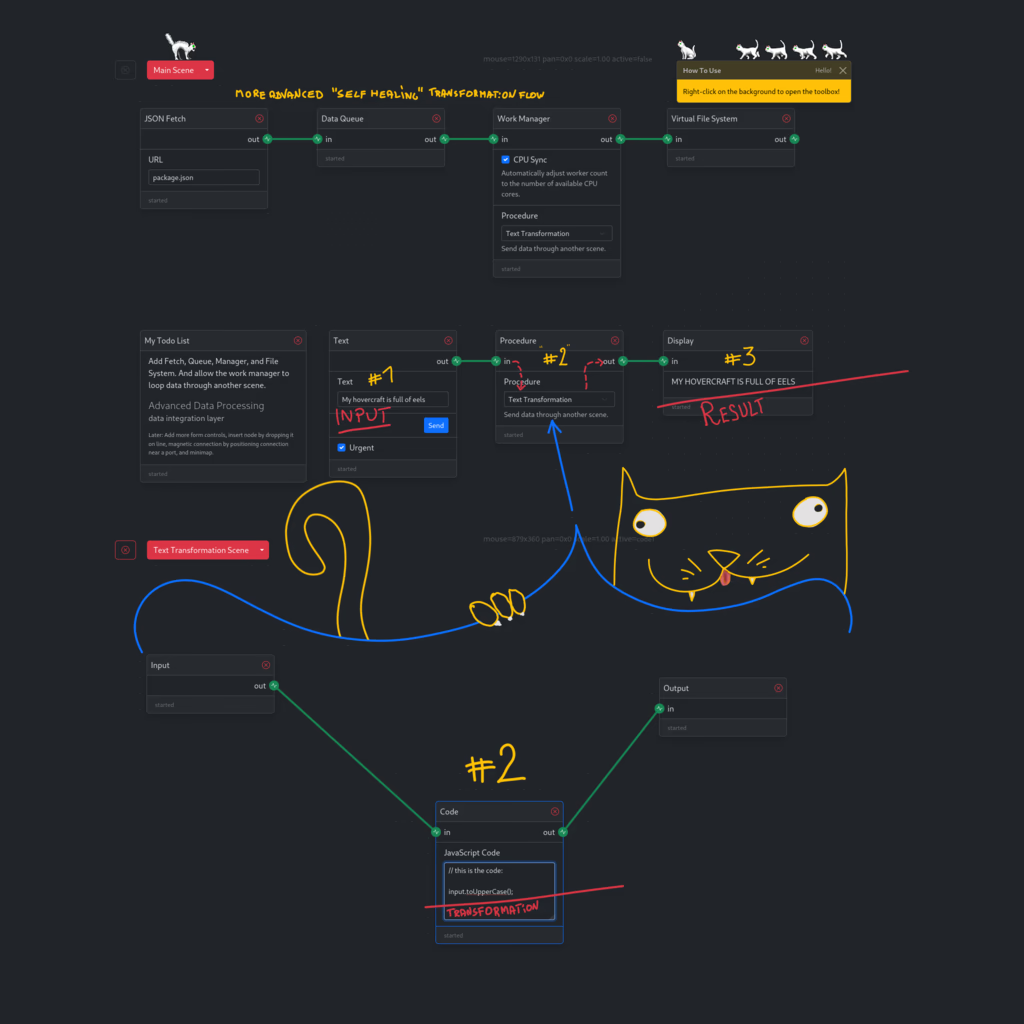
The author presents several poetic versions of âThe Slayer,â depicting a cat who conquers four visualâprogramming challengesâserial, parallel, selfâhealing, and pipeâwaitingâand thereby simplifies the process for the coder while opening it up to new creators.
#1809 published 18:51 audio duration1,625 wordspoetryvisual-programmingserial-processingparallel-processingpipesqueuessupervisorself-healing
An astronaut or an injuryârecovery athleteâboth of whom have lost significant muscle massâis envisioned performing a fullâbody, continuous standing dumbbell routine to rebuild strength. The routine involves cycling through biceps, front, and overhead lifts without rest, synchronized to rhythmic beats so the body stays in motion for a full hour each day, five days a week; an interval timer helps eliminate pause periods. By keeping the weights balancedânot too light yet not heavy enough to force stopsâthe plan aims to build endurance first, then muscle size through constant movement rather than isolated sets. The post asks whether such a continuous dumbbell cycle will indeed restore lost muscle mass.
#1808 published 08:04 audio duration606 wordsexercisedumbbellfull-body-workoutmuscle-atrophy-recoveryastronautissgym-routineinterval-trainingmusic-beats
The post argues that culture is a humanâmade construct rooted in kinship and expressed through accumulated wisdom, which can be viewed as a series of commandments or principles that guide modern life; however, not everyone will follow all these principles, and the author stresses that mastering them requires continual effortârising each time one fallsâand that true wisdom comes from within. The text critiques the current education system for its memorization focus and describes how this âstandardizedâ approach can make people vulnerable to manipulation. It then lists a set of wisdomâderived principles (selfâknowledge, justice, integrity, rationality, common good, balanced passion, compassion, beauty, humility, honor, courage, defense of the weak, disciplined living, continual learning, moderation, evidence over belief, etc.) as the foundation for modern culture and concludes that embracing these ideas will unite humanity toward collective flourishing.
#1807 published 12:05 audio duration1,010 wordsphilosophycultureeducationwisdomself-awarenesslearningknowledgeprinciplescritical-thinkingglobal-cooperationenvironmentarts
The post argues that fitness and bodybuilding are essentially the same pursuit, with bodybuilders simply adding more weight over time. It stresses that the key to building muscle is not lifting heavy for a few seconds but rather focusing on workout duration: start with light dumbbells, work out for an hour like aerobics, eliminate rest breaks, and gradually increase weight in small increments (2â2.5âŻlb) as you become comfortable. By keeping a steady beatâone up, one downâyou create a rhythmic âdanceâ that makes the session enjoyable and sustainable. In short, itâs the duration of effort that drives muscle growth, with added weight coming only after youâve built endurance.
#1806 published 03:33 audio duration363 wordsfitnessbodybuildingdumbbellsworkoutaerobicsexercise
Embarking on the journey from obesity to bodybuilding begins with leaving your job and daily habits behind, then equipping yourself for hiking and camping as you embrace an adventurous lifestyle that ends overeating. Your training revolves around endurance walkingâviewed as a machine-like process that transforms your body as it adaptsâand gym workouts that mirror this by using light dumbbells in long, continuous sets to build muscular endurance; start with the smallest weights, lift them front, up and side for an hour, then double the duration while maintaining rest intervals similar to jogging. By following this routineâfive days a week with two rest daysâyouâll see weekly gains, improved mobility (like reaching down or fastening a seatbelt), and increased stamina that carries over into your outdoor excursions; the key is consistent, lightâbutâeffective lifts coupled with rhythmic motion set to music, turning a oneâhour session into a dance trance that ultimately fuels fat loss and muscle growth.
Gyms work best for those who already possess basic fitness and understand how to use machines; otherwise, beginners should start with simple walking or light cardio until they build endurance, then gradually add weight trainingâbecause building stamina first allows the body to adapt to heavier loads without overâstraining circulation. The post argues that many people hit a plateau because they jump straight into heavy lifting without mastering basic movement, while true muscle growth comes from sustained effort and proper rest periods; once endurance is established through walking or lowâintensity cardio, adding structured weight training becomes more effective and safer, especially for older or larger individuals who need gradual progression.
#1804 published 11:47 audio duration938 wordsgymfitnessexercisewalkingendurancemuscle
In 2025, breakthroughs ranged from Japanâs legalization of rapid humanâanimal hybrid creation to AIâdriven antiâaging drugs entering trials and NASA announcing Mars colonization by the 2030s, marking a year of transformative advances in biotechnology, artificial intelligence, and space exploration.
#1803 published 18:39 audio duration2,046 wordshuman-animal-hybridsbiohackinggenetic-engineeringai-biotechnologyantiaging-drugbioprintingnanostructuresbrain-computer-interfacequantum-computingmars-colonizationcrisprfusion-powerspace-exploration
The author explains how âSwitchMapââa term that combines âswitchâ (referring to observables) and âmapâ (the transformation of values)âis an idiom that feels natural only within the functional reactive programming community; they recount their own learning curve, from struggling with map/reduce/filter code in CouchDB queries to finally grasping the operatorâs meaning after many weeks of practice, and conclude by recommending that beginners build their own FRP system or study the Observable proposal (WICG/Tc39) as a practical entry point into the world of observables and functional reactive programming.
#1802 published 05:10 audio duration456 words4 linksreactive programmingrxjsobservablefunctional reactive programmingjavascriptcouchdb
This post argues that progressive, steadyâweight trainingâillustrated by a jogger who gradually adds light dumbbells while running an hour a day for two yearsâeffectively builds muscle because the body adapts over time; it contrasts this method with short bursts of heavy lifting, which are less efficient because they lack sustained load and adaptation. The author explains that even modest increases (from 3âŻlb to about 20âŻlb total) can produce noticeable gains in legs, shoulders, arms, core, and back, while heavy lifts performed only for a few seconds each session fail to stimulate longâterm growth unless done regularly over many months. The post concludes that consistent lightâtoâmoderate training, whether on the road or in the gym, is a reliable way to build muscle and extend life.
#1801 published 10:24 audio duration1,032 words2 linksjoggingdumbbellsinterval-timergymfull-body-workoutmuscle-growthendurance-training
A âSubscribableâ is a simple container that holds an array of subscriber functions with `subscribe` and `unsubscribe` methods; `subscribe` returns a tiny anonymous function that will automatically call `unsubscribe`. An Observable builds on this by adding a single method `notify(data)` that pushes the given data to all subscribers. A Signal further extends an Observable by storing a value property: when a subscriber is added it immediately receives the current value (if defined), and the signalâs setter updates the stored value and calls `notify` so all listeners receive the new data; the getter simply returns the stored value. In this way, signals provide a lightweight reactive pattern similar to RxJS, where data changes are broadcasted to any interested callbacks.
#1800 published 07:02 audio duration596 words1 linkjavascripttypescriptobservablesignaldesign-patternsreactive-programmingevent-driven
The narrator opens with a brief note about the return of Michigan geese and Punxsutawney Phil as winter settles in, then shifts to a vivid encounter with a squirrel that froze him when it approached too closelyâits little grab on his ears and a bite at his nose adding a touch of humor. He follows up by recounting how he tried to feed the squirrel acorns (after buying them from a store whose cashier sent him to âthe back woodsâ), all while reflecting on weather folklore involving groundhogs and gerbils, and finally closes with the geese thinking winter was over only for it to get cold again.
#1799 published 02:43 audio duration343 wordspoetryweathersquirrelsacornsmichigangeesewinter
This post explains why building muscle is essential for staying fit and young, using animals like chimpanzees, horses, and tigers as examples that move constantly to maintain strong muscles. It describes how gradual, continuous exerciseâstarting with light dumbbells and slowly increasing weight and durationâhelps the body adapt without excessive soreness, and stresses that consistency in movement, rather than heavy lifting at once, is key for muscle growth and recovery. The author advocates a routine of several hours per week, emphasizing steady progression and rhythmic motion to keep muscles flexible and resilient, ultimately presenting bodybuilding as an effective antiâaging treatment.
#1798 published 08:11 audio duration616 wordsmuscleexercisebodybuildingtraininganimals
The post recounts three different âsavantsââfirst a gifted but mentally ill man who predicted a fire and used timeâmail to alter events; second a brilliant astronomer who documented new stars with his telescope; and third the everyday readerâs own potential as a savant in learning programming. The author weaves these anecdotes into a personal exhortation: by mastering languages like JavaScript, embracing AI tools, and persisting through disciplined practice, anyone can unlock their full creative power and lead an extraordinary life of continuous growth and exploration.
#1797 published 09:59 audio duration937 wordssavantsmemory palacesprogrammingjavascriptaiself improvement
JavaScriptâtogether with its rich ecosystem of frameworks such as Electron, Node.js, React Native, and Ionicâlets you write code that runs on servers, desktops, websites, browser extensions, smartphones, and tablets with about 95âŻ% or more reusability.
#1796 published 17:00 audio duration1,880 wordsjavascriptelectronnode.jsdenobunnw.jsreactvuesvelteangularwebcomponentsionicreact-nativecouchdbmongodbpouchdblowdbwasmwebassemblydesktop-appsserver-sidemobile-devcross-platform
The post urges readers to cultivate a wellârounded life by immersing themselves in knowledge, physical activity, and creative practice: it recommends listening to an audio book each day (especially adventure, science, philosophy, and fiction titles) to absorb wisdom from othersâ lives; encourages spending ample time outdoorsâwalking, hiking, campingâto develop survival skills and balance work with nature; emphasizes regular exercise and muscle building through progressive weight training; suggests using a projector to create large canvas paintings as a creative exercise that blends art and color theory; and concludes by advocating programming as the âmeta careerâ that can be paired with artistic study to prepare for future challenges, all aimed at becoming a great being.
#1795 published 08:09 audio duration775 wordsreadingaudiobookhikingbodybuildingpaintingprogrammingart
The author begins by contrasting the rigid, teamâdriven mindset of many programmers with his own maverick, solo approach, praising the clarity and stability of structured code while noting its narrowness. He then explains the difference between Observables and Signals in functional reactive programmingâObservables being selfâcleaning, complex programs with operators, whereas Signals are simple reactive variables that just broadcast valuesâand illustrates combineLatest with an analogy involving email updates from three senders. Finally he reflects on his own focus: mastering JavaScript (ECMAScript) and visual programming while using AI to emulate patterns from other languages such as Erlangâs OTP, Prolog, and functional constructs like map, filter, reduce, thereby blending borrowed ideas into a flexible, maverick workflow.
#1794 published 08:00 audio duration667 wordsjavascriptreactive-programmingobservablessignalscombinationlatestfunctional-reactive-programmingvisual-programming-languageai-generated-codeecmascript
The author reflects on how philosophy begins in childhood curiosityâasking âwhyâ and seeking answersâand develops into a lifelong practice of questioning everything, from everyday education to the mysteries of the universe. He recounts personal experiences: learning programming independently, feeling that school was merely transactional; traveling to America, exploring UFOs and early religions after hearing Dana Sculley; reading about Bigfoot, aliens, dinosaurs, and realizing these stories are fantasies that spark curiosity. He cites several thinkersâSagan, Bryson, Dawkins, Dennett, Robinson, Rees, Krauss, Myers, Carroll, Filippenko, Tarter, Shostakâto illustrate how philosophy gave birth to the sciences by prompting inquiry, evidence gathering, and discovery. Ultimately he sees becoming a young philosopher as a steppingâstone that empowers one with evidence and the power to spot lies, fulfilling a duty to both humanity and oneself.
#1793 published 06:08 audio duration594 words12 linksphilosophyself-learningeducationufology
This post argues that you can write maintainable, futureâproof JavaScript without any framework by building a simple treeâbased structure under your app, using signals for data binding and WebâŻComponents whose templates are multiline HTML strings (Bootstrap CSS is used for styling). The tree acts like a file system or Redux store; each node holds other nodes but never gets moved around, so the UI layer simply renders the correct component types via the tree. Signals drive updatesâtext inputs push values into signals that trigger reârendering without loopsâand all DOM manipulation is done with plain import maps and no build step. In short, a vanilla approach of signals + WebâŻComponents + a flat recursive update model gives you an easy way to keep code working for years while avoiding the overhead of JSX, document fragments or complex reconcilers.
#1792 published 10:06 audio duration679 words1 linkjavascriptwebcomponentssignalsdomimport-mapsfrontend
The post celebrates the imaginative idea that all beings of the stars possess a âpurrculatorâ and can purr as loudly as cars, using playful rhymes and repetitive imagery to encourage selfâeducation, curiosity, and growthâboth intellectual and physicalâand invites readers to pursue programming, adventure, and an enduring legacy while keeping their minds sharp.
#1791 published 02:50 audio duration257 wordspoetrycreative-writinginspirationalastronomyeducation
The post argues that the conventional school system is largely ineffective, leaving graduates feeling lost and underprepared; it urges readers to take ownership of their learning by immersing themselves in books, nature walks, and selfâdirected explorationâparticularly through programming and AIâto build a dense personal knowledge base that fuels curiosity and creativity. By treating education as an adventure rather than a prescribed curriculum, the author believes one can rise above poverty, overwork, and stress, ultimately becoming a âcreature of the starsâ who thrives on continuous discovery and selfâguided mastery.
#1790 published 09:20 audio duration697 wordseducationself-studyprogrammingtrailsbooksai
The post explains how to use an interval timerâeither a free app or a simple clipâon deviceâto structure workouts that alternate short work periods (e.g., 30âŻseconds of dumbbell lifts) with calculated rest intervals, thereby avoiding the common mistake of treating timers as ânoârestâ tools. It argues that lifting heavy for only half a minute does little beyond maintaining muscle and that true growth comes from gradually adding weight or time to each set; sets and reps are labeled a bodybuilding myth. The author recommends starting with light dumbbells (3â5âŻlb) on basic exercises such as lateral raises, curls, and overhead presses while following 100â120âbpm music, timing lifts, and then extending the work duration until you can sustain nonâstop effort for 45â60âŻminutes before adding heavier weights, faster tempo, and longer sessions (up to two hours a day, five days a week). In short: consistent incremental load with wellâtimed rest leads to real muscle adaptation.
#1789 published 05:42 audio duration540 words3 linksinterval-timerdumbbellsworkouttrainingyoutubemusic-tempo
Bodybuilding is treated here as an endurance activity that lasts for hours and relies on consistent, nonâstop lifting rather than short sets; the post stresses that choosing a weight you can lift through each rep (neither too light nor too heavy) allows continuous motion and gradual progression. The author recommends doing standing dumbbell exercises daily while synchronizing lifts to the beat of fresh musicâa âdance tranceâ that keeps focus high. By gradually increasing tempo and load, one can train both strength and rhythm. Adequate nutritionâprotein, dried fruit, peanutsâand proper hydration with sugar and salt are also highlighted as essential fuel for adaptation and smooth transformation. The overall message: keep the workout continuous, musicâguided, progressive, and nutritionally supported.
#1788 published 05:05 audio duration398 wordsbodybuildingdumbbellworkoutmusical-temposets-repsexercisenutrition