What Else Can Today’s Artificial Intelligence Do?

What Else Can Today’s Artificial Intelligence Do?

zoom read listen

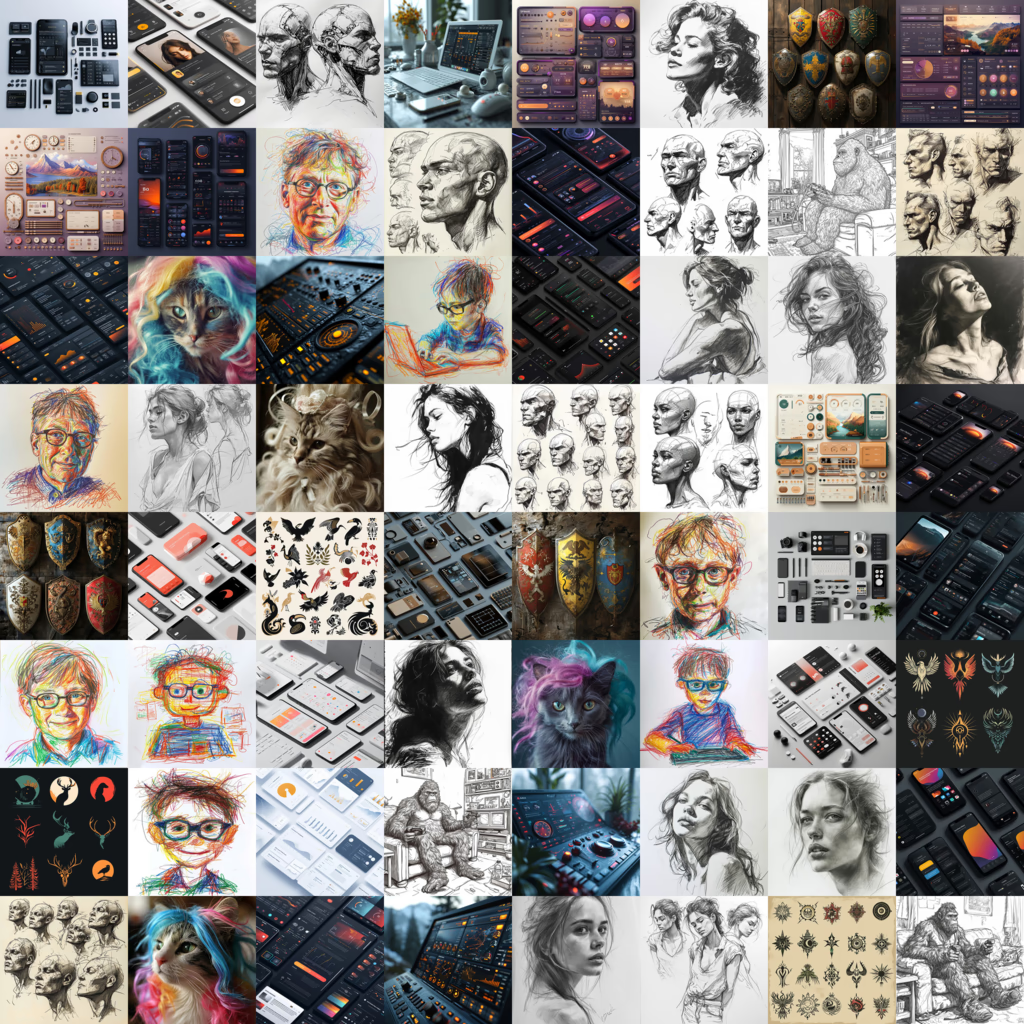
The post explores how current AI can generate both text and images to produce complete books—ranging from story outlines to detailed chapters—and then turn those into finished products such as audiobooks, coloring books, drawing references, or even simple graphic assets like tarot cards, UI kits, logos, and business‑card designs. By feeding the model with a list of topics or sample images, it can craft coherent prose, illustrate scenes in crayon style, or design intricate borders for card decks; all while remaining fast and inexpensive compared to manual creation. The writer notes that this technology will reshape professions—from authors and designers to programmers—by allowing anyone to produce polished content in seconds, though the final output still requires human review and refinement.

#1403 published 13:43 audio duration 1,181 words ai text-generation book-creation illustration coloring-book drawing-reference ui-kit web-design programming-books tarot-cards business-card

Fever Dreams; Or, Artificial Intelligence Makes You A Powerful Fashion, Interior and User Interface Designer

Fever Dreams; Or, Artificial Intelligence Makes You A Powerful Fashion, Interior and User Interface Designer

zoom read listen

The author reflects on the current state of artificial intelligence, noting that while full‑scale AI is not yet available, we already possess large language models that can generate creative outputs such as fashion designs, interior layouts, and web UI kits. They encourage readers—especially young people in cities—to learn programming and harness these tools for small businesses, producing and selling software or design products like clothing patterns and hats. The post stresses the importance of embracing AI rather than avoiding it, suggesting that using open‑source models (e.g., LLAMA2) will make one more capable, faster and ready for the future where AI will be integral to everyday life.

#1402 published 06:57 audio duration 538 words 1 link ai llama2 programming design fashion webdesign svg ui-kits llm open-source small-business future technology

Retro Futurism To The Rescue; Or, Chasing All The Bugs

Retro Futurism To The Rescue; Or, Chasing All The Bugs

zoom read listen

The post envisions a new way to “fix” computers by returning to simple, low‑power design and replacing complex, centralized software stacks with a distributed, visual‑programming framework. It proposes that apps be built from interchangeable nodes or puzzle pieces—much like the collaborative editing of an online encyclopedia—so users can copy, customize, and remix them on their own devices without relying on central servers. By combining AI‑enhanced incremental updates, local database copies, and a data‑stream programming language, this approach promises snappy performance, retro‑futuristic aesthetics, and better privacy: users control their own themes and styles while developers can design programs through clear diagrams of connected labels and lines.

#1401 published 08:04 audio duration 512 words 2 links visual programming node based programming app development retro design vector graphics local databases distributed apps data flow diagrammatic programming

Visual Programming Done Right

Visual Programming Done Right

zoom read listen

The post argues that visual programming—viewed as a language akin to the Linux command line—offers scalable, reliable, and fast development by letting you compose tasks with reusable nodes. It can range from low‑level to high‑level abstractions, enabling everything from simple UI kit generation for Bootstrap to complex domain‑specific tools like web scrapers, HTTP servers, music composition interfaces, or ffmpeg filter graphs. By generating code on the fly and allowing live design, visual programming makes deployment trivial while keeping complexity manageable at the right abstraction level.

#1400 published 21:06 audio duration 728 words visual-programming node-based drag-and-drop ui-builder code-generation linux-cli web-frameworks ffmpeg audio-composition theme-creation

Resolution Meow; Or Get Buff, Fluff and Gruff

Resolution Meow; Or Get Buff, Fluff and Gruff

zoom read listen

A high‑frequency, no‑rest gym routine that begins with tiny weights, employs full‑body motion, music‑synchronized intervals, and interval timers to keep lifting continuous is described as a way to rejuvenate and extend life.

#1399 published 10:26 audio duration 671 words gym weightlifting dumbbells intervaltraining repetitions sets music tempo fullbodymotion

Big Bada Obesity Boom!

Big Bada Obesity Boom!

zoom read listen

The author argues that childhood obesity can be both a hidden advantage for building muscle and an early warning sign of future health problems; they describe how excess weight gives children more strength but also limits mobility, and suggest that parents must feed their kids properly or else the kids will inherit obesity’s toll. The post lists practical steps to lose fat: avoid sugary, processed foods, eat calorie‑low lettuce salads, track workouts with a calculator, gradually increase walking endurance, use music to keep rhythm, and incorporate dumbbells, dancing, and jogging into training. They also encourage long hikes on the Appalachian, Pacific Crest, and Continental Divide trails as a way to stay active, reduce food consumption, and give a sense of accomplishment. Finally they claim that removing kitchen appliances from home will help prevent overeating.

#1398 published 13:27 audio duration 743 words obesity childhood-obesity muscle-building diet exercise hiking gym lettuce

Programmer’s Retirement; Or, Don't Let The Office Slow You Down

Programmer’s Retirement; Or, Don't Let The Office Slow You Down

zoom read listen

After leaving the corporate grind, you should let your first bright idea bloom and then repeatedly “role‑play” it—write documentation, create a reference implementation, debug with Rubber‑Duck style, and refine until the program is lean and clear; once the final version feels like a tiny machine, embed sarcasm in its design to tame complexity, even if that means building mini‑OS services or syncing a lightweight database across nodes; by iterating this process you’ll discover simple automata‑like mechanics, keep state with integer counters and snapshots, expose data structures over HTTP, and ultimately produce a “Sarcastically Small” system—an elegant, minimal framework reminiscent of HyperCard, ColdFusion, CouchDB, or NodeRED—that can be built upon for future projects.

#1397 published 12:57 audio duration 647 words programming documentation refactoring distributed-systems paxos

Missy Klepto Kissy: The Legendary Seagull Mama Of Westland Crossing

Missy Klepto Kissy: The Legendary Seagull Mama Of Westland Crossing

zoom read listen

Her love for humans is unmatched, and she is deeply attached. She lives atop a ladi‑da modernist light, watching us even at night. From great heights or in flight, in all her beautiful might boundless is the power of her sight. She really likes fish, but it is her old favorite dish. Unspiced spaghetti is now her favorite food, though cereal with vitamins is also good. She loves to snack on unshelled sunflower seeds, but salt is not something she really needs. She was born at Lake Michigan, where she visits now and again. But when living in a parking lot makes her weary, she often flies to Lake Erie. It is only a short flight away, and she can make the trip in a day. There her many boyfriends hang out, and always greet her with gifts as large as trout. She is the most beautiful of Michigan birds; it is not possible to describe it with words. Many geese and ducks, often a squirrel or two, just visit to say “How do you do?” They keep company for days and weeks, adventuring to local rivers and creeks. But be it adventure or vacation, or just the pleasure of bird aviation… She always returns to her parking‑lot home atop her fancy light dome. For Missy Kissy loves us all, and she really is the loveliest seagull.

#1396 published 02:47 audio duration 230 words seagull bird lake erie lake michigan

Indoctrination, Education, And Prevention

Indoctrination, Education, And Prevention

zoom read listen

In this essay the author argues that the world is being pulled in two directions: a quiet, invisible force of indoctrination that shapes minds into “dark ages,” and a countervailing power of self‑education that can lift people into greatness and prevent war. He links the rise of conflict to cultural influences such as music and the lack of true learning, and stresses how children’s education and protection are essential for a future free from endless wars. By reading books, listening to narrations, exploring personal interests (like programming or art), and continually revisiting knowledge, individuals can build a legacy that turns them into teachers themselves—an act he sees as the only real tool to stop war before it starts.

#1395 published 13:11 audio duration 1,020 words education learning war books culture children

Hacking Holidays And Retro-futurism At The House Of Meow

Hacking Holidays And Retro-futurism At The House Of Meow

zoom read listen

The post argues that today’s AI needs a visual programming language to manage code in node‑based structures and critiques the fragmented state of web UIs, especially on government sites where users feel “stupid.” The author proposes auto‑generating UI from relational database rows—like Access or FileMaker—to create panels automatically, and envisions a middle HTTPS proxy that caches data and serves it under a uniform interface while AI assists with manifest handling. To prototype this idea he built Signalcraft—a lightweight SVG‑based reactive OOP framework inspired by Blender’s geometry nodes—during a hackathon, finishing project templates and file I/O on an 11 pm deadline, though error messages remain rudimentary.

#1394 published 08:18 audio duration 571 words 2 links visual-programming javascript yoga svg responsive-layout database-rows proxy-caching signalcraft

Visual Programming Languages; Humanity's First Cybernetic Enhancement

Visual Programming Languages; Humanity's First Cybernetic Enhancement

zoom read listen

Visual programming languages (VPLs) are presented as powerful, personal tools that act as extensions of our own thinking—capable of turning simple ideas into functional programs and even automating everyday tasks like controlling a thermostat. By serving as an interface to the world and a concept map for anything we care about, VPLs let us “drag‑and‑drop” nodes that represent real programs, making coding feel like a natural part of our lives. When coupled with AI, they become even more powerful: we can ask an assistant to generate image lists, produce graphics, upload them as merchandise, and build entire e‑commerce workflows—all within the same visual environment. Though current examples are slow and clunky, the author argues that future VPLs will feel like second‑nature extensions of ourselves, turning programming into a true cybernetic enhancement rather than a job skill.

#1393 published 09:10 audio duration 725 words visual-programming-languages ai-integration node-based-programming automation open-source

My Little Program

My Little Program

zoom read listen

I recently explored Blender’s geometry nodes from a programmer’s perspective and noticed how the editor’s input boxes behave—switching mode immediately after a mouse press—which sparked my interest in visual programming tools. In building my own lightweight framework, I extended JavaScript’s Object and Array to reactive versions so that components update automatically without relying on heavy libraries like Svelte or JSX; this approach lets me keep code readable while still supporting complex UI hierarchies. My design philosophy blends flat and skeuromorphic themes—drawing inspiration from graphic‑design concepts such as color theory—to create a flexible, zoomable interface that works well even on low‑power single‑board computers. Ultimately I’m aiming to provide an open‑source visual programming language that lets users drag‑and‑drop components, mod the application freely, and see all system parts connected in an interactive diagram—so coding becomes a tool for inventing rather than the end itself.

#1392 published 20:14 audio duration 933 words 1 link blender geometry-nodes svelte typescript coffeescript jsx ast javascript oop nodejs svg html dom visual-programming reactive-objects low-powered-sbc

Every Computer Program Is Once A Beautiful Story As Clear As Day

Every Computer Program Is Once A Beautiful Story As Clear As Day

zoom read listen

The post explains how a programmer can grasp a program by studying its notes, diagrams, and source code, and why keeping a reference implementation helps to see the structure clearly. It then describes a version‑control scheme where each file gets a unique random name and a version number so that edits made while offline are merged later without loss. Finally it stresses how telling the story of an application’s architecture—whether to another programmer or even to a rubber duck debugger—is essential for clarity, learning, and mastery.

#1391 published 09:45 audio duration 784 words 5 links programming version-control file-editing collaborative-editing debugging architecture reference-implementation pixelart rotoscoping rubber-duck-debugging

The Tiny Little Workout

The Tiny Little Workout

zoom read listen

Music fuels workouts—beat-driven drummers set the pace while you lift light dumbbells and dance to keep moving; refresh your playlist often so it stays energizing, and if people stare or laugh, frame it as shuffle‑dance practice. Start with an interval timer for beginners—one minute of activity followed by one minute rest—and gradually shrink the rest periods until you reach 30 minutes non‑stop, then repeat the process to build up to an hour and beyond; keep the routine five days a week, double your duration when it feels easy, and pair it with a varied diet low in sugar—this combination will produce an athletic body, extended range of motion, and potentially add years to your life.

#1390 published 06:13 audio duration 473 words music workout dumbbell interval dance exercise routine playlist

The Supremely Boring World Of Visual Programming & Diagramming Tools

The Supremely Boring World Of Visual Programming & Diagramming Tools

zoom read listen

Visual programming tools let you model a process that includes a human‑in‑the‑loop step—like appointment scheduling or a self‑checkout—by representing the human task as an inbox or TODO item that can be triggered by a simple icon on the canvas; when the icon fires, the human receives a notification, completes the task, and the system receives their response to continue the workflow. This approach turns a complex, error‑prone programming problem into a visual drag‑and‑drop sequence of boxes and connections, so that changes such as adding AI or a new UI can be made safely by linking components with conditions or numeric values like “businessLevel.” In practice it means that business processes (from a simple parking‑lot queue to a customer’s smartphone checkout) can be built, managed, and reprogrammed in a visual interface while keeping the underlying logic clear and changeable.

#1389 published 06:50 audio duration 577 words visual-programming workflow-automation human-in-the-loop drag-and-drop diagramming-tools business-process-modelling

Life After AI; Or, Eternal Living, Forever Young

Life After AI; Or, Eternal Living, Forever Young

zoom read listen

Today’s post discusses how recent drugs can extend the lifespan of large dogs, while cloning technologies preserve pet DNA for future use; humans have already begun using medicine to lengthen their own lives, and cryogenic freezing is a speculative but hopeful extension method. The author then shifts to artificial intelligence, describing it as still faint yet growing from copies of human collective knowledge, suggesting future AI will design personalized medicines—first adding 25 years, then another 75 via cellular de‑aging—to achieve lifespans around 175 years. Parallel processing and AI’s rapid growth are framed as transformative forces that could solve famine, war, pandemics, and revolutionize learning, all happening at “super luminal” speeds beyond current assembly lines. The post concludes by comparing this wave of change to the early car era: people once imagined faster horses, but now we face unprecedented technologies that will reshape life extension, medicine, and AI in the next decade or less.

#1388 published 14:43 audio duration 994 words life extension cloning medicine dog medicine animal cloning dna preservation organ transplantation cryogenics ai drug design parallel processing

A Tiny Look At The Wild Wild West Of Visual Programming

A Tiny Look At The Wild Wild West Of Visual Programming

zoom read listen

The post explains how visual programming can be structured around “control panels” with defined “sockets” that accept reusable component panels—high‑level panels (like a song or book) plug into more generic ones (text panels, image or audio processors)—and how connecting these sockets is managed by the language itself. It gives concrete examples: an AI‑generated book where a high‑level book panel connects to chapter panels, which in turn connect to text panels that can use functions such as lodash’s array joins; for media it suggests ImageMagick/ffmpeg or Tone.js for audio. The author notes that these panels generate shell scripts (or browser commands) that are then executed automatically or manually, making the visual program self‑documenting and more readable than traditional directory trees and diagramming.

#1387 published 08:04 audio duration 639 words 4 links visual programming component-based design reusable components code generation shell scripting lodash imagemagick ffmpeg tone.js

Bonkers Honkers; Or, The Noise Of The Gaggle Convoys

Bonkers Honkers; Or, The Noise Of The Gaggle Convoys

zoom read listen

The author describes life in quiet Michigan lake towns—named “land of Never Again”—where little activity keeps people feeling blue, but the yearly arrival of Canadian geese turns into noisy convoys that bring a touch of excitement; they hope for snow to send the birds back home, and while their departure feels sad it also signals climate change.

#1386 published 01:59 audio duration 190 words poetry geese migratory-birds lakes weather

Don't Become Your Teacher’s Punch Line; Or, Philosophy And The Urgency Of Authentic Education

Don't Become Your Teacher’s Punch Line; Or, Philosophy And The Urgency Of Authentic Education

zoom read listen

The author reflects on how teachers often never fully grasp the impact of their work, yet take pride in a long career; he argues that true learning comes from following one’s own curiosity and proper sequence rather than rigid schedules or standardized metrics like grades and resumes. He contrasts “real life” with scripted achievements, insisting that knowledge must be lived and practiced—through hands‑on projects, exploration of books, and real experiences such as hiking—to become a creative, self‑driven professional rather than merely an employee guided by HR reports. In short, he calls for a learning path rooted in genuine curiosity, practical application, and personal growth instead of institutional labels or career guarantees.

#1385 published 10:38 audio duration 651 words education learning school career knowledge personal growth essay

The History Of Our Greatest Heights; Or, Why We Will Always Need Philosophy

The History Of Our Greatest Heights; Or, Why We Will Always Need Philosophy

zoom read listen

Mis‑readings of concepts like “Gentle Lady” erode virtues and halt progress, but philosophy holds the ideas that can restore those values.

#1384 published 07:44 audio duration 405 words philosophy culture language words

The Friendly Superpower Of Reactive Programming

The Friendly Superpower Of Reactive Programming

zoom read listen

In this post the author explains how crossing “streams”—a concept borrowed from physics and ghost‑busing—becomes a powerful tool in programming, enabling recursion and colorful fractals. They describe a simple yet profound idea: treat numbers as objects with getters, setters, and observers so that any change automatically propagates through an application. Extending this pattern to visual programming, the author shows how to create a new “color” data type, add a picker, sort it in the toolbox, and embed it into programs while keeping everything reactive. The result is a self‑editable, community‑driven workflow where changes are instantly reflected, making visual reactive programming less complex than traditional game development.

#1383 published 08:02 audio duration 753 words reactive visual-programming data-types number-observers color

Fitness Myths: Diet, Sets & Reps, Machines, And A Real Shortcut

Fitness Myths: Diet, Sets & Reps, Machines, And A Real Shortcut

zoom read listen

Protein powders and supplements are largely ineffective; for a healthy diet, eat well and let exercise burn fat rather than relying on restrictive diets or protein pills. A mixed diet with all food groups keeps the body balanced like caring for a delicate kitty—avoid excess sugar or starvation but include varied nutrients to prepare for adventures and common colds. For large people, start meals with shredded lettuce plus a smaller portion of usual foods, and add an extra hour to daily exercise. In the gym focus on continuous movement rather than counting sets/reps; free‑movement exercises build balanced muscle groups better than isolated machine work. Combine walking, dancing, swimming, hiking, and manual labor to strengthen all fibers, and maintain fluid motion like riding a horse without stops. Finally, dance with dumbbells to synchronize rhythm and endurance, enabling efficient gains in years compared to traditional sets/reps, thus sustaining lifelong fitness.

#1382 published 08:06 audio duration 635 words fitness diet nutrition protein powders exercise gym workout walking hiking dance

Become A Programmer; Or, Learn For Real Because Discomfort May Just Be A Sign Of A Fake School

Become A Programmer; Or, Learn For Real Because Discomfort May Just Be A Sign Of A Fake School

zoom read listen

Adults often give vague advice such as “trust your gut” or “follow instinct,” while students are told to ignore their feelings and rely on parents’ savings; the real key is using one’s own brain, learning at a pace that satisfies existing knowledge, which is what true education should do. Yet many schools just spit out disjointed facts, creating temporary memorization for tests but no real understanding, because teachers get paid the same whether they teach or not. This “ghoul” system also underlies other problems—medicine prices, privacy loss, drug legalization, women’s choices—and it forces people into low‑skill jobs that machines will soon replace. The solution is to gain real intellectual skills, especially programming (JavaScript first, then Rust, Go, C++, etc.), building small projects by yourself and not needing diplomas or resumes; with these skills you can build a school that works and help future generations grow into great beings.

#1381 published 06:40 audio duration 541 words self-learning programming-languages javascript rust go c++ open-source education

What Does Programming Feel Like?

What Does Programming Feel Like?

zoom read listen

Programming is likened to building sandcastles—an endless creative process where the real reward lies in continual learning rather than finishing a project; the author distinguishes between being a programmer and working as one, noting that true work emerges when you build and experiment with your own ideas. He celebrates how modern tools—browser extensions, AI, reactive programming, and code generation—enable the creation of unique visual languages, MUDs (text adventures that can be expanded into full-fledged games), and browser‑based digital audio workstations that let programmers compose music as a form of art. By pursuing a personal project he believes one turns coding into an artistic craft that sharpens the mind, offers endless loops of exploration, and ultimately lets you harness cheap robots, drones, 3D printers, microcontrollers, and AI to build complex systems—turning simple programs into powerful, self‑reinvented creations.

#1380 published 06:22 audio duration 587 words programming learning browser-extension ai mud audio-workstation music creative