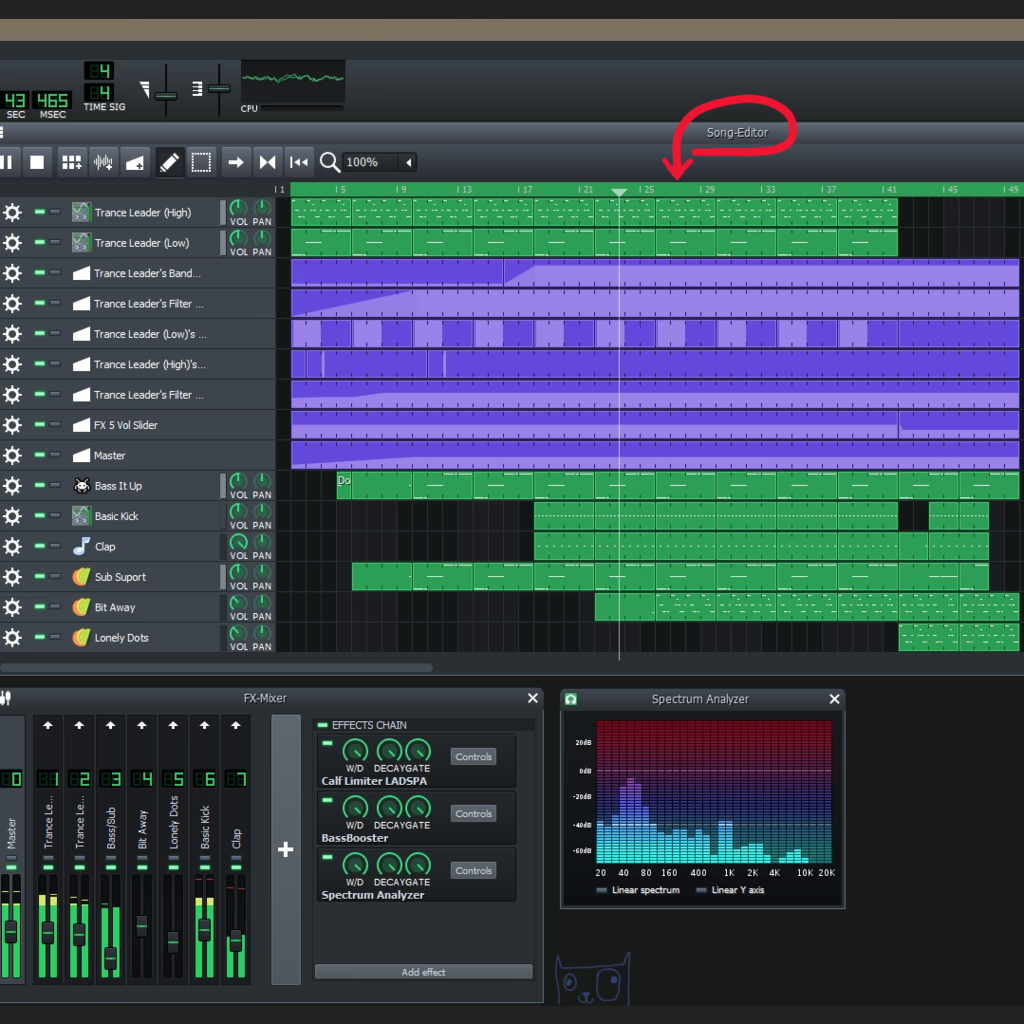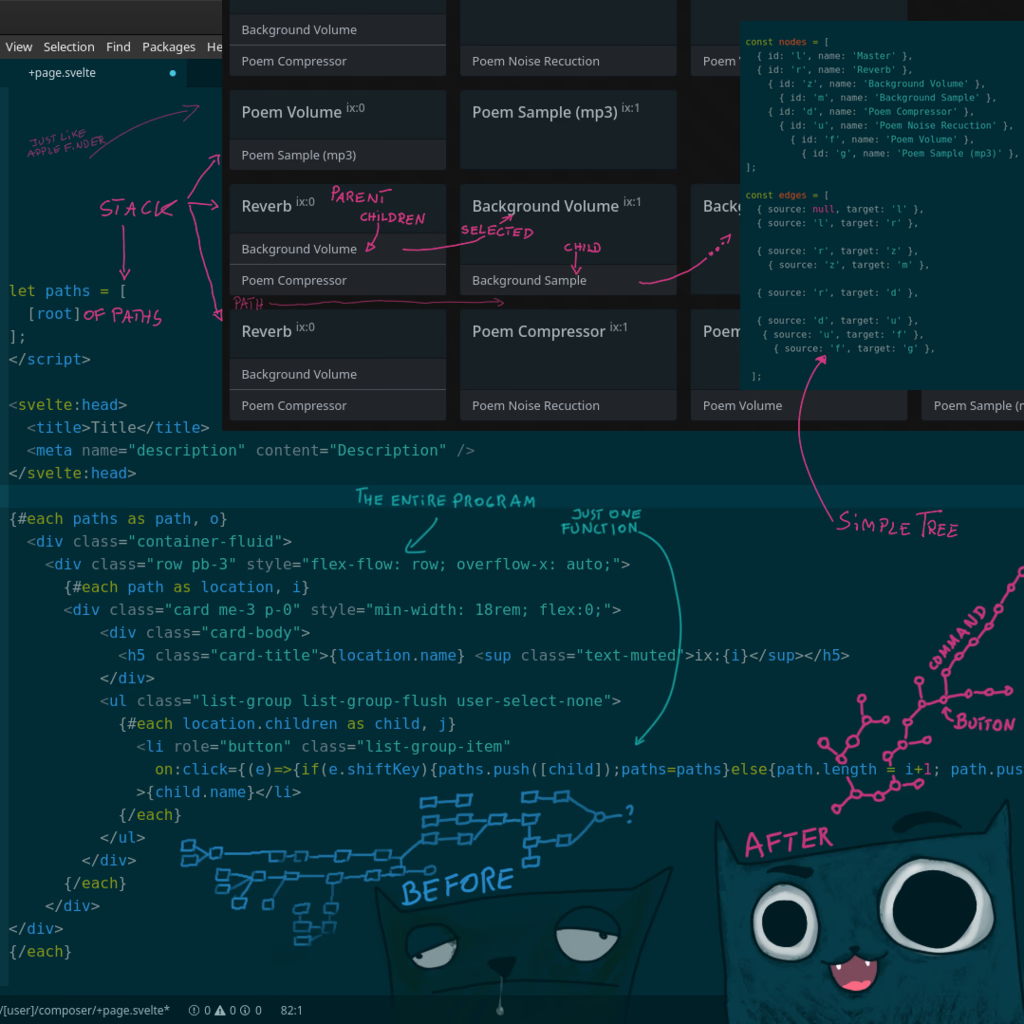
Doodle diagrams are a flexible, creative way of visualizing ideasâespecially useful for programmers before formal mindâmaps or concept maps take shape. By sketching everything from many angles with markers, they let you break down complex interfaces into simple building blocks; the author shows this by dissecting LMMSâs song editor into just two elementsâthe time track and draggable rectanglesâto make a small clone in JavaScript and Svelte. The post also argues that doodle diagrams help clear scattered thoughts and relieve workârelated stress, encouraging developers to keep notebooks full of colorful sketches as they craft side projects or launch their own startup, while pointing out useful online tutorials for JS, Svelte, and LMMS.
#1187 published 08:37 audio duration646 words3 linksdoodle-diagramsmind-mapsconcept-mapsjavascriptsveltelmmsweb-audio
The post reflects on human development as a continuous âgrowing upâ process that transcends mere aging and involves acquiring wisdom through inheritance, analogy, and synthesis. It argues that this intellectual growth is rare, limited to a few capable beings, and that true learning arises from personal responsibility rather than rote memorization or institutional grades. The author calls for selfâeducation via reading great works and engaging in reflective adventures, suggesting that individual progress fuels humanityâs collective advancement.
#1186 published 08:27 audio duration644 wordsgrowthself-educationphilosophybookslearning
The author argues that humans should grow continuously into great beings who make lasting contributions, yet those in control often suppress independent thought; while we can detect overt advertising, subtle automated recommendations like âOther users also watchedâ are harder to notice and influence opinionsâso the solution is authentic selfâeducation: follow your curiosities, not just school grades, embrace adventure, and taste creativity so that you become unshakable.
#1185 published 05:11 audio duration324 wordsself-educationpersonal-growthaiautomationrecommendationsadvertising
In this post, the author argues that programming is a powerful, selfâdirected tool for building businesses and learning, rather than a hobby or talent limited to a few. He encourages readers to embrace software developmentâespecially using JavaScript, Node.js, Svelte, and SvelteKitâas a means of creating online ventures, licensing products, or launching multiple startups until one succeeds. By mastering these technologies and staying attuned to community trends, one can turn simple code into a company, generate AI art, control microâcontrollers, and ultimately gain the freedom and creativity that formal schooling often fails to provide.
#1184 published 03:52 audio duration291 wordsjavascriptnodejssveltesveltekitstartupselflearning
The author reflects on the limitations imposed by traditional schoolingâcramming, financial strain, and cultural wars that stifle creativityâand urges readers to tap into their own inner genius. By studying books, philosophy, and engaging in selfâdriven exploration (journaling, drawing, programming), one can break free of the cycle of rote learning and economic hardship, synthesize ideas, and rise above the clouds of ignorance; ultimately, through persistent study and imagination, anyone can become a beacon for others to follow.
#1183 published 08:05 audio duration501 words1 linkessayphilosophybooksreadinglearning
The author recounts how they started preparing their superheroâstyle Halloween costume months ahead, noting that the effort is worthwhile and continues to pay off throughout the year. They describe an encounter at the gym with a mailman who had a military background, whom they jokingly reminded to "put on some muscle," while the authorâs own tail caught his attention, sparking laughter. The narrator reflects on this moment repeatedly, noting that early costume preparation allows ample time for testing and refining the outfit. They emphasize how wearing such an outfit feels empoweringâlike armorâand even suggest that a tail is essential for balance, muscle development, and hiding weapons, concluding that superheroes should embrace their tails just as great apes do.
#1182 published 03:15 audio duration345 wordshalloweencostumesuperherotailgympoetry
The post explains that when building complex visualâprogramming applications it is more efficient to start from the top levelâcreating a tree of categories and containers (windows, layouts, buttons) before writing individual functionsâso that each component already has a designated slot for its logic, eliminating the need to manually wire sockets or assemble many lines of code; by nesting actions inside this hierarchical structure, developers can avoid reconnecting events, keep the underlying data model simple like a file system, and let users add patterns (e.g., audio instruments) without extra UI steps, thus making the overall design more intuitive and maintainable.
#1181 published 05:37 audio duration499 wordsvisual-programmingsveltetree-data-structuresui-layoutprogramming-structure
The post describes an informal âdonutâchasingâ fitness challenge that encourages readers to train for long walks and runsâstarting with simple strolls, gradually progressing to jogging and even triathlonâstyle mileageâwhile equipping themselves properly (reflective jackets, sturdy shoes) and avoiding overâexertion. It stresses the importance of a consistent routine: cutting sugar, working out to music beats, using interval timers, and treating workouts as longâterm commitments rather than oneâoff events. The author shares personal anecdotes (e.g., âsloshâ training from raisin donuts) and recommends incorporating hiking or camping trips to boost weight management and overall health, ultimately aiming for a lifelong habit that can extend life expectancy and bring joy to family.
#1180 published 11:13 audio duration931 wordsrunningwalkinghikingexercisefitnesstriathlonultramarathondonutsgym
The post argues that true learning comes from selfâdirected, individualized education rather than rote memorization; it stresses the importance of teaching students to program as a way to experience accomplishment and creativity, while also encouraging them to read and study philosophical works through narrated books so they can grasp history, ideas, and wisdom. It portrays teachers as thinkers who bring powerful ideas, and insists that each person must take responsibility for their own educationâstarting with intellectual classics, moving to philosophyâs history, and ultimately becoming a catalyst for change through personal growth and mastery of both technology and thought.
#1179 published 06:36 audio duration525 wordsself-educationprogrammingphilosophybookshikingpersonal-development
The post argues that schools often act like bureaucratic factories producing uniform outputs rather than true learning; it stresses that poor education leads to bad results and war, and that genuine learning is measured by personal growth and lasting contributions, not just grades or diplomas. It calls for a shift toward practical subjectsâespecially computer programmingâthat empower students to lift themselves out of poverty, providing open video lectures, projects, and startup accelerators involving parents; it ends by noting that anyone can become a teacher if teachers are absent and that mastery in programming offers endless rewards and confidence.
#1178 published 06:43 audio duration502 wordseducationschoolprogramminglearningcurriculumtechnologyvideolecturesstartupacceleratorparentinvolvement
The post argues that learning is most effective when driven by personal curiosity: memorization alone is shallow, but grasping a concept naturally pulls one toward related branches, creating a cyclical, selfâreinforcing cycle of discovery and mastery. It emphasizes that the mind focuses on what interests it, ignores the uninteresting, and that this dynamic interplay of attraction and expansion fuels genius, brilliance, and success.
#1177 published 02:43 audio duration212 wordslearningmemorizationconceptualizationcuriositymindsetself-development
The author argues that true learning comes from handsâon practice and selfâdriven exploration rather than the rigid structure of formal schooling. Using a personal anecdote about watching a family member create beautiful desktop apps, they illustrate how real lectures feel like seeds that grow into deep knowledge when nurtured by curiosity, experimentation, and continuous codingâe.g., building with Electron, Svelte, or CSS themes. They describe a learning cycle where grades disappear, only the thrill of mastering concepts remains, and each new project fuels further growth. The piece ends by urging readers to view education as an ongoing journey that transcends boundaries and culminates in becoming a selfâfulfilling, creative force.
#1176 published 09:07 audio duration517 wordseducationself-learningprogrammingelectronsveltedesktop-applicationslecture
The post envisions a future internet where AI and local storage bring the web into homes, making it stronger, more resilient, uncluttered, and accessible; users download and maintain personal copies of desired content, use custom tools like Svelte, NodeRED, or libraries such as svelvet to crawl and organize data, while AIâdriven spiders keep their collections updated; this localâfirst model promises improved privacy, reduced reliance on ads, and gives individuals control over search engines and software robots, though not everyone will keep a full copyâonly the parts they value.
#1175 published 05:55 audio duration576 words2 linkssveltegunjavascriptnode-redaiwebdevelopmentofflinecopyofinternetdataloggersvelvetchartrooms
The post argues that diagramming is the key tool for mastering complex programming tasks such as implementing dragâandâdrop interfaces: by sketching out nodes, data types, events, and coordinate updates (often fired every 50âŻms) you can see the flow of operations and avoid confusion. The author stresses using precise markers on paper or digital tools to create clear visual diagrams that guide your coding sequence, and suggests searching for âdragâandâdrop tutorialâ whenever a concept feels unclear. Finally, they challenge readers to apply this approach by building a browser plugin that autoâscrolls sites, stores articles in a simple database, and offers a dragâandâdrop UIâincluding a trashcan featureâto demonstrate how diagramming turns abstract ideas into concrete code.
#1174 published 06:54 audio duration585 words1 linkprogrammingdrag-and-dropuidiagramstutorialsbrowser-plugindatabasesvelvet
The post argues that true fitness starts with simple lifestyle changesâeliminating comfort items like the TV, toaster, microwave, oven, and refrigeratorâand then gradually building a workout routine that begins with walking and interval training, incorporates light dumbbell lifts (starting at 3âŻlb per hand), and progresses to dancing-like exercises; it also suggests adding outdoor activities such as camping or hiking to keep things fresh. By following this gradual, comfortâfree plan, one can regain full mobilityâtwisting, turning, bendingâand ultimately extend life expectancy by up to fifty years.
#1173 published 07:23 audio duration365 wordsfitnessgymworkouthome exercisewalkingdumbbellsinterval timerroutine
The post treats programming like a form of worldâbuilding that depends on navigation skillsâsuch as memory palacesâthat evolved to support our intelligence; it then shows how these techniques are applied in code, with examples ranging from MUDs (programmable multiâuser dungeons) to data streams that can carry binary data or OOP objects. It explains that finite state machines simplify programs by replacing many ifâstatements with explicit states and transitions (e.g., loading â ready â error), thereby eliminating edge cases while still allowing creative, guarded flows.
#1172 published 07:05 audio duration575 wordsprogrammingstate machinefinite state machinestreamsdata streamingoopmudworld buildingmemory palace
Philosophy, the post argues, is a mindâmultiplying force that lets us converse with our elder selves and grasp their regrets, while its questioning spiritârooted in observation and inquiryâmakes it the âMother of Sciences.â By reflecting on religionâs comfortâbased inventions and the flawed idea of standardized education, we see how both can be turned against a nation. The text distinguishes academic philosophy (a tool to teach thinking) from plain philosophy (the unrestricted art of questioning), noting that this practice lets us independently pull wisdom from the universeâstarry nights, fragrant summers, snowy adventuresâand map our personal cities and mountains. In doing so, philosophy becomes an encoded program in all thinking creatures, upgrading our operating system and guiding us to meaning through a quest for knowledge, greatness, and collective convergence of cultures in peace and laughter.
#1171 published 07:40 audio duration550 wordsphilosophypoetryself-reflectionmind-multiplicationelder-self
Philosophy is portrayed as the ultimate superâpower and operating system of the mind, enabling adaptation, resilience, humor and creative expression. The author likens philosophers to programmers whose works read like computer programs written in poetry, wisdom, kindness and inspiration, and presents learning philosophy as continuous questioning, integration of ideas, early attention and iterative correctionsâmuch like codingâthat lead to selfâeducation, adventure and invention. By adopting a stepâbyâstep observation and synthesis process one becomes a lover of wisdom, not merely by accumulating knowledge but by integrating it into a coherent personal system that helps rise and ultimately contribute authentic ideas for world peace.
#1170 published 07:09 audio duration534 wordsphilosophyeducationlearningprogrammingartself-educationintegration
Today, the author argues that modern education fails young people by treating them as a resource to be mined for money rather than nurturing curiosity, which leads to poverty and war; he calls for an overhaul that uses engaging, relevant topicsâespecially programmingâwhich integrates math, physics, chemistry, art and philosophy, allowing students to learn through real projects instead of rote memorization. By combining selfâevaluated subjects with narrative books and handsâon software development, learners can build knowledge on the shoulders of giants, break the cycle of mediocre teaching, and take responsibility for their own learning so that they become great beings capable of positive contributions.
#1169 published 09:34 audio duration597 words1 linkprogrammingweb applicationsself-learningeducationbookstechnology
The post explains how to design an internal API with clear function categories (e.g., signIn/signUp, addProduct/buyProduct) and simple, flat grouping so that each group contains only related functions; it then introduces a permission system where users belong to groups that grant specific rights such as canBuy or canDeleteAccount, and shows how to layer validation rules (StrongPassword, ValidProductID, UnderRateLimit) on top of those API calls. To visualize the whole setup, the author suggests building a âfirewallâlikeâ table that lists all functions with their categories, required permissions, and validation rules, as well as a live dashboard that highlights executed calls in real time (e.g., blinking rows or tick marks). Finally, he recommends adding a âRed Team User Interfaceâ that simulates OWASP attacks to test the systemâs resilience, concluding that creating such tools not only protects code but also deepens understanding and fuels creativity.
#1168 published 10:41 audio duration680 words5 linksapiinternal-apipermissionsvalidationdashboardvisualizationnode.jssveltesveltekitsp5.js
The post argues that mastering simple, widelyâused programming patternsâsuch as dropdown menus for option selection and set operations like union, difference, and intersection to merge database tablesâis key to building reliable, maintainable software. It explains how these patterns enable straightforward UI features (search, navigation, wizards) and data manipulation (reports, charts), showing that once you understand the underlying logic, you can create functional applications with minimal effort and low cost. The author stresses that these familiar patterns are both educational and practical, making responsible software development approachable and not intimidating.
#1167 published 10:10 audio duration892 words7 linksprogrammingpatternsdatabaseuiwizardrecord-browsercrudlodash
After reflecting on schoolâs shortcomings, the post argues that selfâdirected learning in programmingâbeginning with p5.js, then Svelte and Node.jsâand building small businesses are the real paths to personal growth and success.
#1166 published 22:58 audio duration1,763 words4 linksp5.jssveltenode.jsjavascriptfrontendbackendself-learningsmall-businessycombinator
The author argues that learning web security is surprisingly accessible to beginners because it rewards creative coding over deep experience, and proposes starting a small business that crafts AIâresistant CAPTCHAs using tools like p5.js, Svelte/Kit, and Node.js. By generating visual challenges that current generative models canât easily solveâranging from simple doodles to interactive 3D puzzlesâdevelopers can both learn programming and offer clients a practical service that boosts their security against automated attacks. The post invites readers to explore existing p5.js examples, research AIâweak questions, and build a marketplace where each successful challenge earns the creator a fee.
#1165 published 07:01 audio duration594 words5 linksweb securitycaptchap5jssveltenodejsgenerative artaiprogrammingstartup
Each year the bugs seem to leave and reappear without much ceremony, and while Iâm not sure where they go, it feels like theyâre headed for âOh, hi, yo.â This time they came back to Michigan in a fuzzy, buzzing swarm that landed with a thud and bit me repeatedly. I was the first to get bittenâmy grandma once praised my âsweetâ bloodâand after a while I grew tired of their bites, so Iâve started keeping away from night lights and using bugâspray. Though they havenât yet gotten into me again, they have touched me several times this morning, so Iâm on guard even though itâs hard to stay sweet.
#1164 published 02:15 audio duration227 wordspoeminsectsmosquitoesmichiganbug-spray